Thursday, August 24, 2006

Bora-Bora

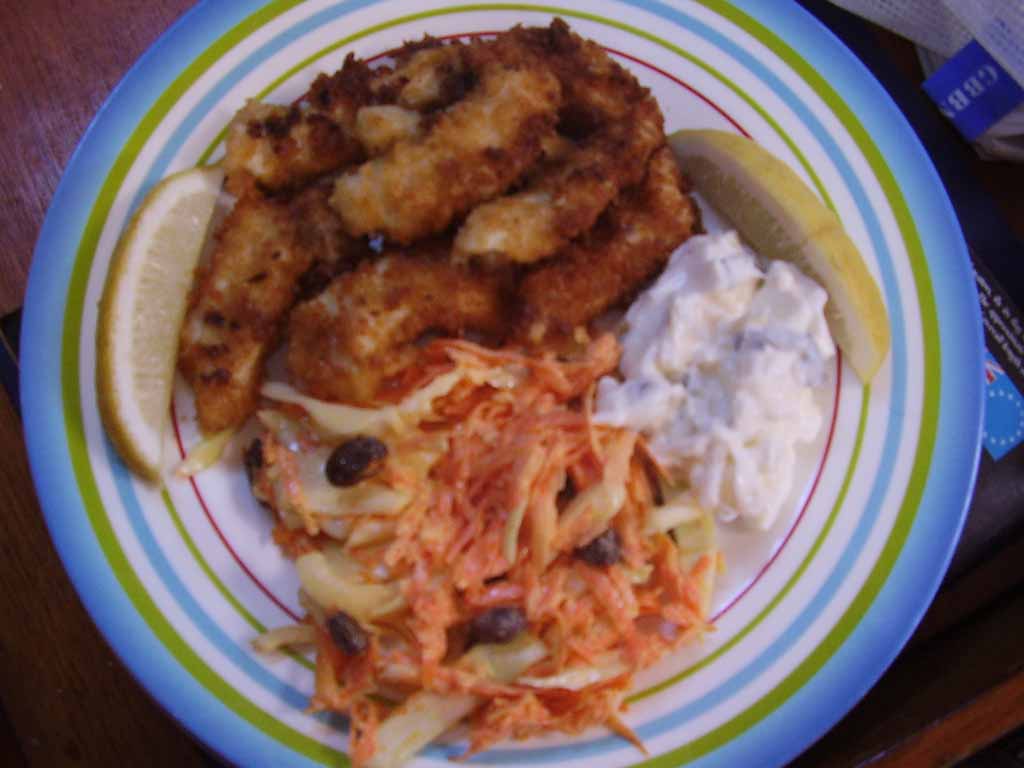
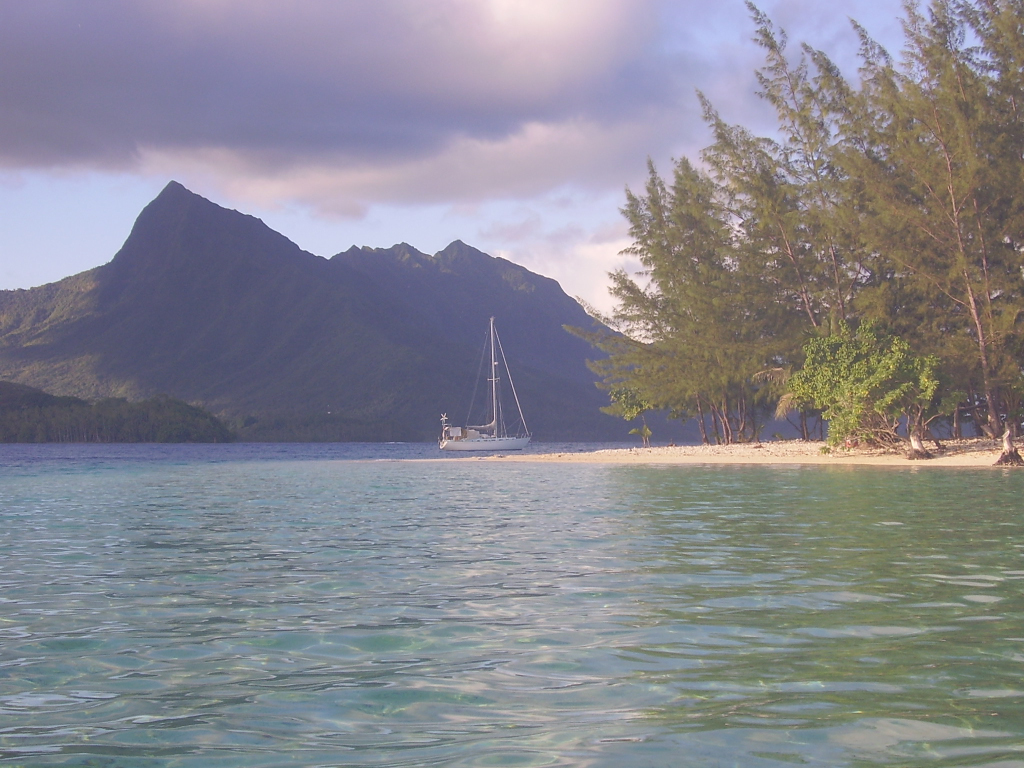
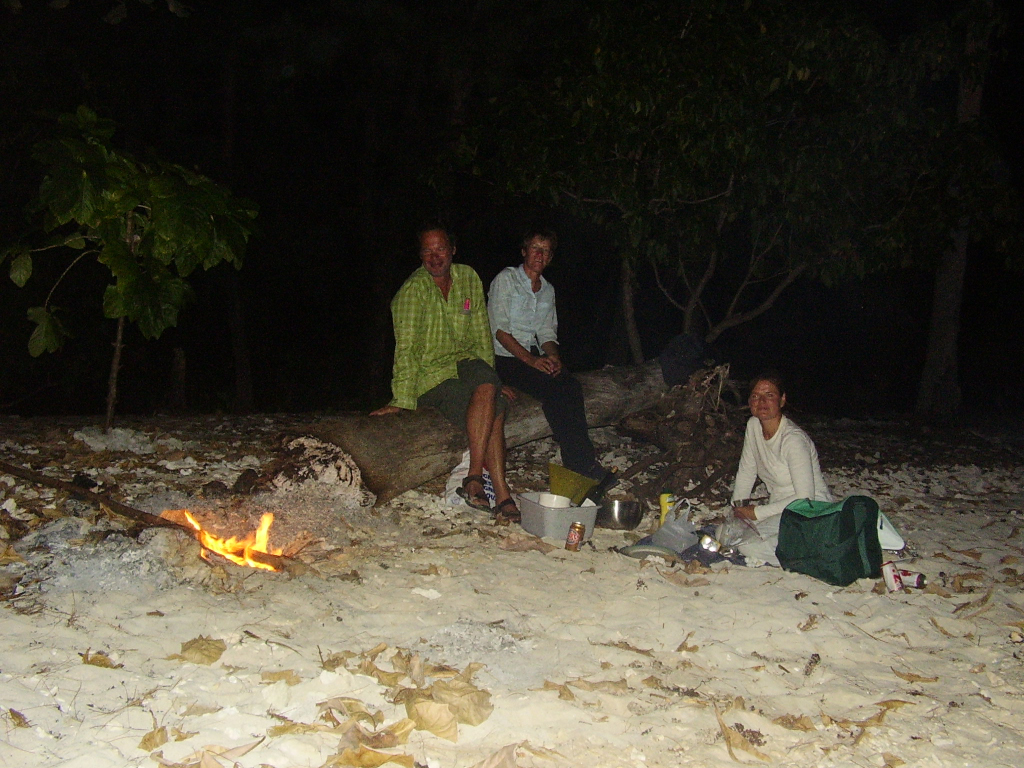
Our stay at Motu Nao Nao to the south of Raiatea was fabulous.It was a landmark of the trip for Nick as he managed to spear his first reef fish there - a squirrel fish. They're quite small and beautiful, and happen to be very good to eat. We took it to show Charles, who lives on Nao Nao, and instead of laughing at our diminutive catch, he was seemingly impressed, gave it the ok as far as ciguatera is concerned and pronounced it 'bon protein, bon protein' and better than 'la viande'. Hmmm, not sure about that, but it was tasty! Noa joined us the next evening and we had a beach fire, baked potatoes and watched the stars.Alas, no fish for supper that day! The snorkeling was excellent - beautiful psychedelic clams and the usual plethora of fish.A walk around the island gave us the opportunity to marvel at the wonder of hermit crabs. They are a new entry in my top ten list of favourite creatures. Their intrepid, incessant explorations while saddled with an awkward, usually oversize second hand shell are so endearing. Their size is also miraculous. What you think is a cluster of sand grains suddenly shuffles into action and heads off with and air of industry - places to go, things to do, people to see! I was tempted to slip a couple in my pocket but decided to leave them to their business on the motu.

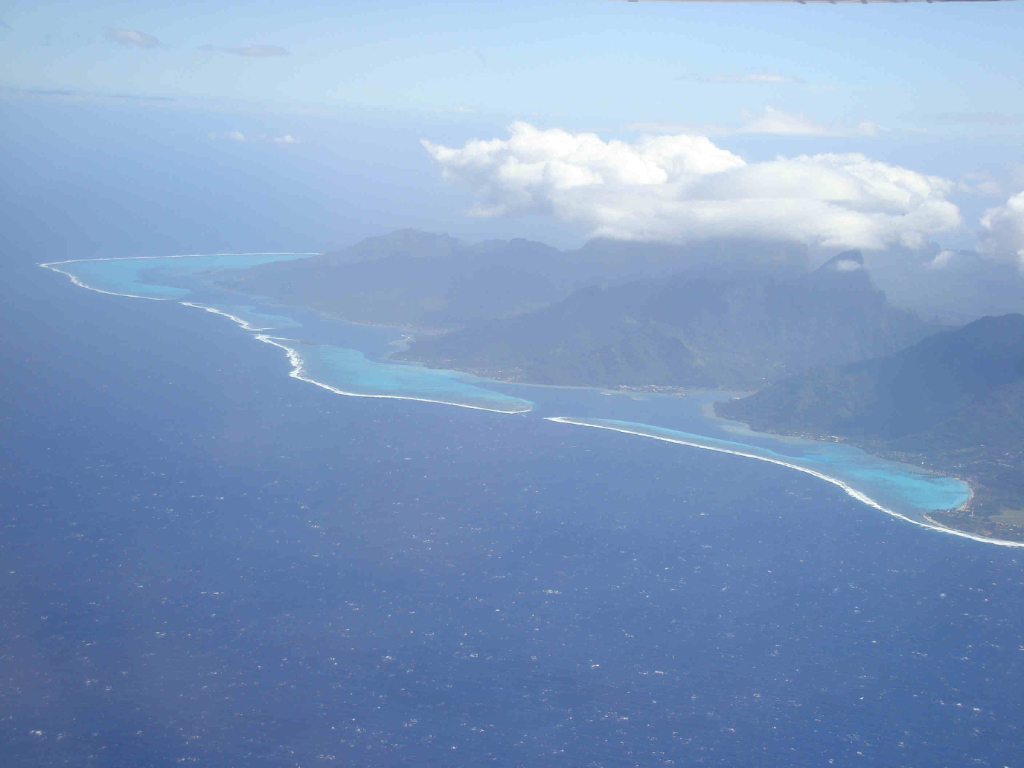
In mid-August, we made our way back north to Raiatea's main town, Uturoa, to take on water and other provisions. We spent the night tied up to the wall which felt very strange. At anchor you get used to your privacy, and to be the focus of curious glances from whoever should be passing felt very intrusive. One couple had a good snoop and I was about to go and confront them when I realised it was Ragtime! Having stocked up we left for Bora Bora which is a short 20 mile hop north west.We had a great sail but unfortunately no joy with the fishing on passage. When we do catch our next ocean fish, it's going to taste so good. We're both wishing for a wahoo. Bora Bora has a stunning skyline and the lagoon is an almost impossible array of hues ranging from deepest blue/black to pale azure.The weather here has not been great for our stay. We've had 20-25 knots of wind in the lagoon which makes snorkeling more difficult, and has probably affected the visibility below the surface. We have seen manta and sting rays in the anchorage, however, one of which leapt 4 feet into the air just ahead of the dinghy as we were heading back to Kika, and scared the flippers off us! Bora Bora feels as if the genuine Polynesian culture has been swamped by tourism, and hotels are still being built on the motus surrounding the island.
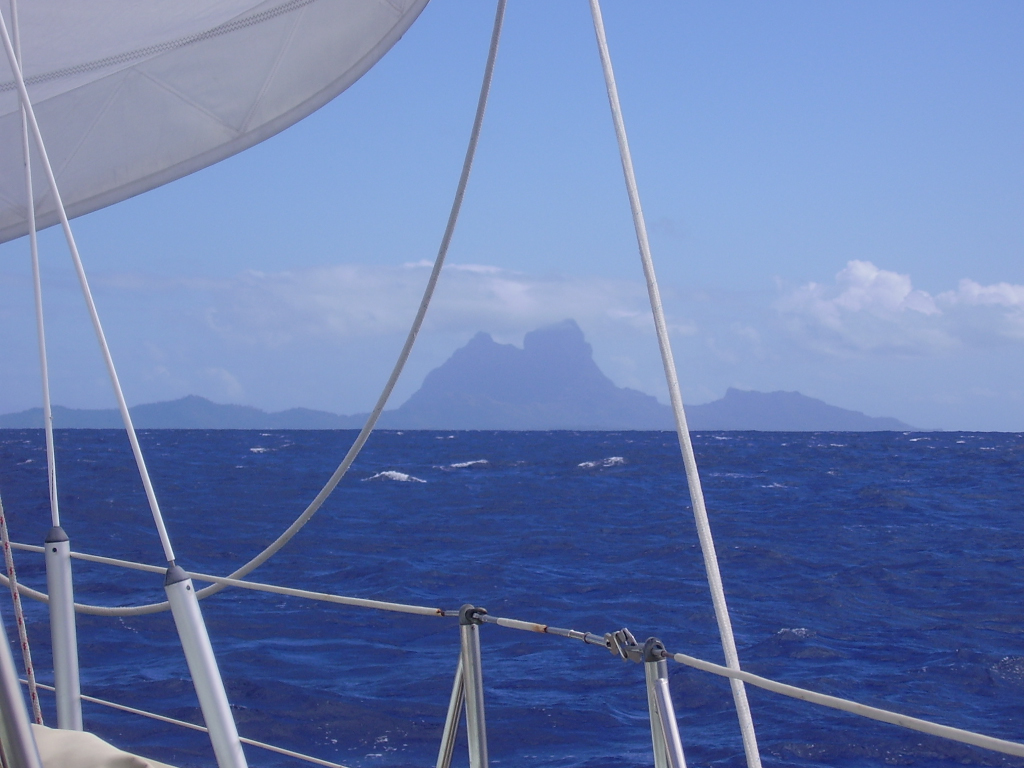
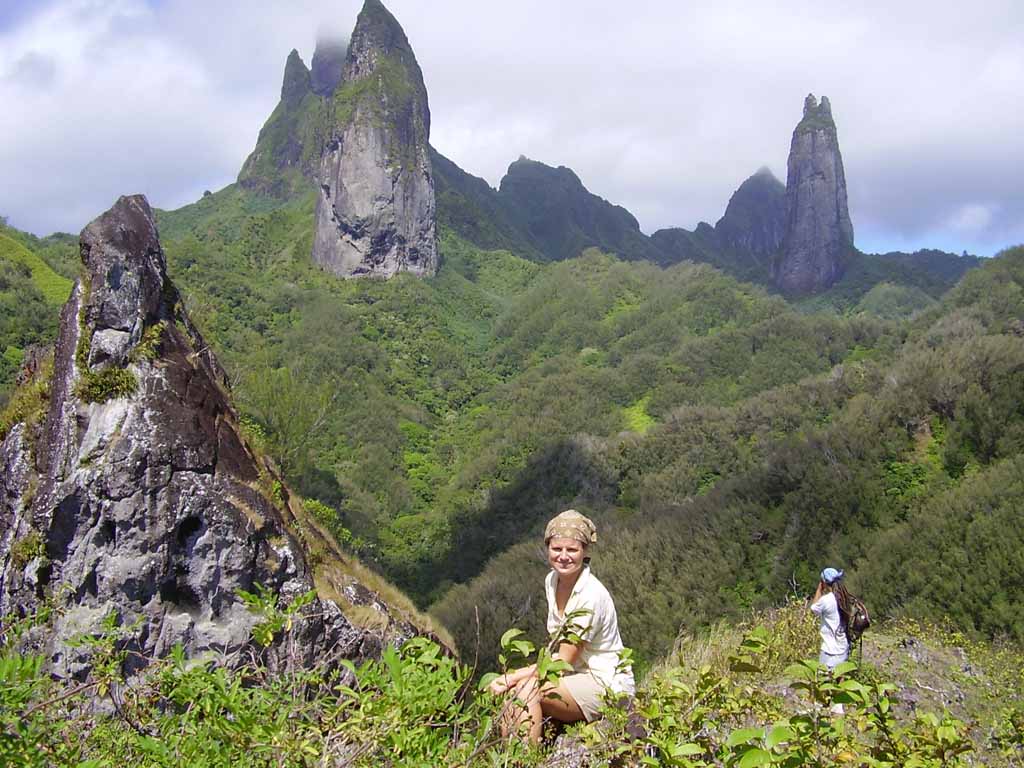
A walk on the mainland revealed more hotels and tourist shops, but heading inland and upwards, we were soon rewarded with fabulous views of the lagoon and we had the opportunity to practise our skills of scrumping amongst the lush vegetation. I managed to grab a tempting breadfruit from an obliging tree, and we had our first taste of breadfruit chips that evening. It is an extraordinary, versatile fruit with a curious texture that, when steamed, is close to mashed potato. Breadfruit was the main mission of HMS Bounty. Captain Bligh was commissioned to transport seedlings from Tahiti to the Caribbean in order to provide food for the slave labour there. The mission failed and history was made in the process!

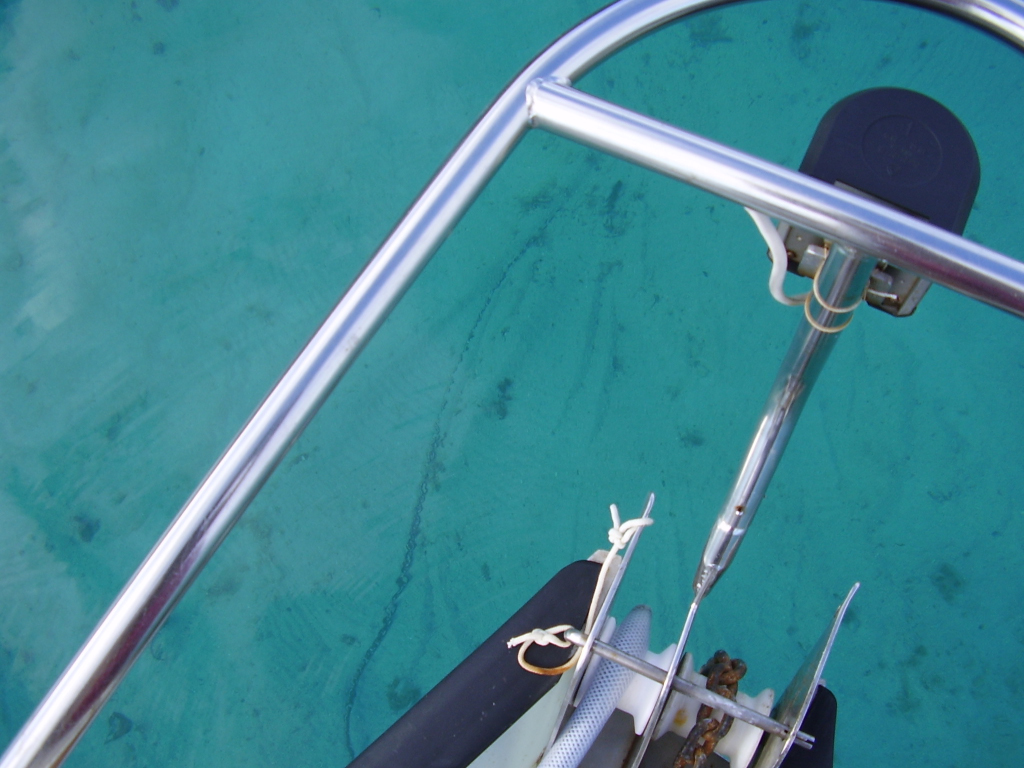
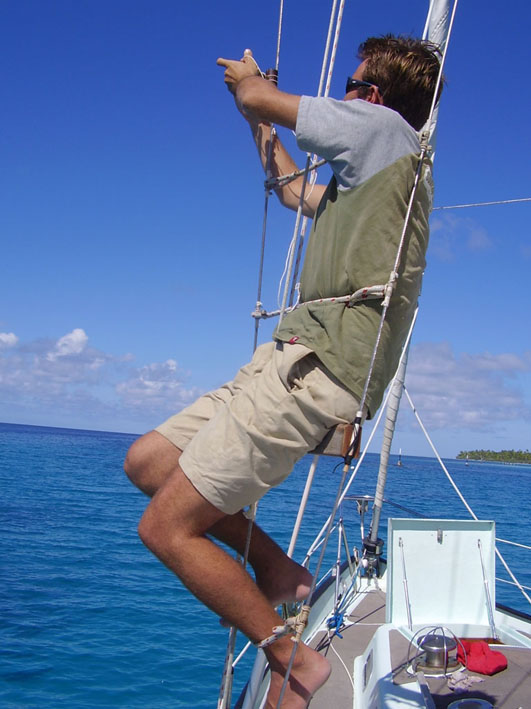
In search of some seclusion, we took Kika around to the East of the island which involved some tricky navigation and thoroughly tested our buoyage skills. Coral dodging around Bora Bora
Coral dodging around Bora Bora
Nick shouted directions from his vantage point up the ratlines, and I helmed, manoeuvring Kika safely through the chicanes and switchbacks which comprise the safe passage around to the east. Arriving there we felt elated at our achievement - we're still building up our confidence around coral after the close encounter in Raroia. The 'seclusion' was limited due to our unavoidable proximity to hotels, but it was great to get another view of the island. The crater dominates everything and its silhouette changes radically as you move around, always dramatic and usually topped with a generous helping of cloud.Yesterday, we returned to an anchorage in the west, with a departure to the Northern Cook islands in mind. The main pass through the reef is to the west of the mainland and this is the only exit and entrance for sailing vessels. We took a quick trip into town for some provisioning, and I was delighted finally, to receive my birthday parcel which has taken a month to arrive from the UK! I almost kissed the owner of the yacht club (who, I'm sure is sick of the sight of me due to my numerous previous visits) when he produced a big package from behind the bar. I think he was quite surprised and I wouldn't blame him if he suspected it contained something more sinister and valuable than birthday cards, magazines, photos and, of course, Werther's Originals! I ask you, what's more valuable than that? So, departure is planned for later today although we are waiting for a weather forecast as, annoyingly, the wind seems to have died. Next stop, Penrhyn in the Northern Cooks. It means a slight detour from our rhumb-line west but from what we've heard, it's well worth it.
Monday, August 14, 2006

Societies

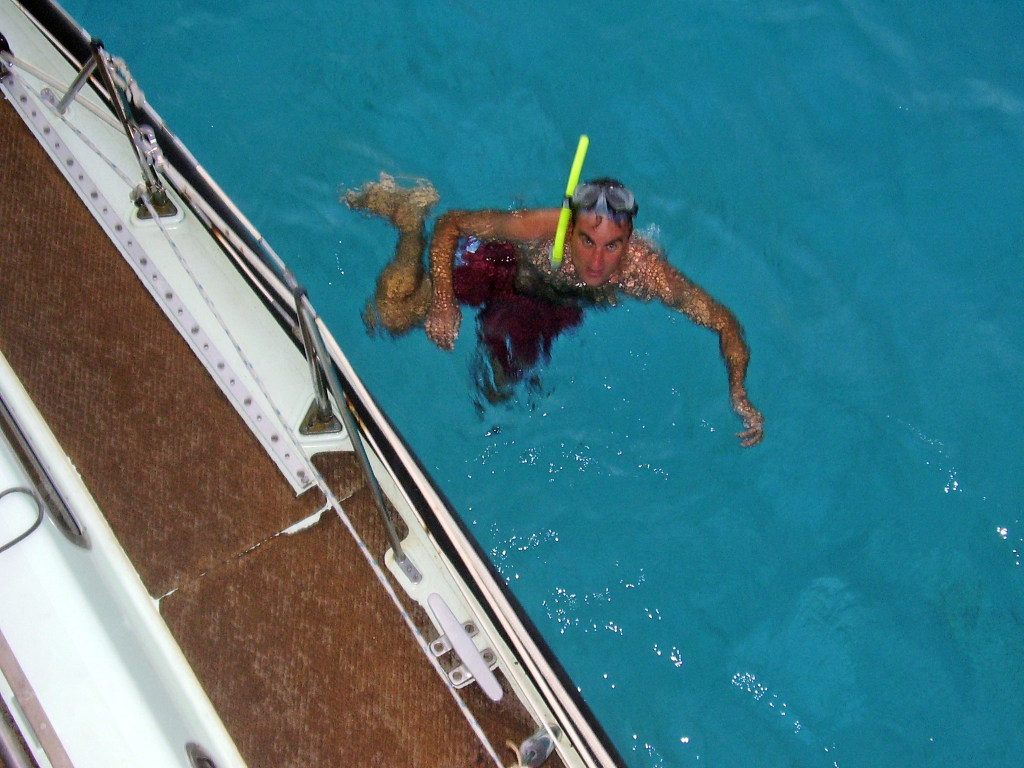
It's been a while since our last update and much has happened; we've celebrated both the anniversary of our departure and Ellen's birthday, we've sampled the delights of Tahiti and Moorea, narrowly avoided exhaust-fume induced asphyxiation, sent our first emails via Australia and we're currently enjoying nearly perfect sailing in the sheltered lagoon around Raiatea and Tahaa.We used Tahiti as a bit of a pit stop, restocking Kika with food, water, diesel, fishing gear and miscellaneous boat bits, while gorging ourselves on the readily available delicious French & Chinese food. We finally saw some Polynesian dancing, exhausted ourselves climbing up to a local view-point and generally enjoyed our rapid re-introduction to civilisation. However it's possible to have too much of a good thing and it was great to escape from the bustle of Papeete to the beauty and tranquillity of Cook's Bay in Moorea.From there we set off with Walter and Rita from Noa for the first of our fruit gathering expeditions, returning with a good selection of papaya. We've learnt from Noa that unripe papaya, when cooked, works well in savoury dishes and our papaya now rarely make it to the ripe fruit stage.

While anchored in Cook's Bay, we dug out our "Mutiny on the Bounty" DVD. It's shot against the tropical back-drop of the mountains of Moorea and it was thrilling to realise that the scenery in the film was identical to the mountains visible from our anchorage. Sadly, reality and fiction have yet to meet when comparing the greeting the Bounty received and Kika's arrival; where the film shows the boat being overrun by goddess-like semi-naked Tahitians, all we received were a few friendly waves from passing fishermen and racing pirogue crews. Next stop was Opunohu Bay, where our anchor disturbed and narrowly missed a ray resting on the bottom. It was a great anchorage in clear water with good snorkelling, fresh baguettes from a nearby shop, a short walk to a mango tree and Zeferin to our starboard.After a couple of days we were ready to head off but were delayed by a temporary fix I'd made to the exhaust in Tahiti turning out to be more temporary than intended. I'd given it a month's guarantee; the fix lasted a few hours. I'd bought parts in Papeete for a more permanent fix, so I took advantage of an unusually wet day to rip out the old pipe. Ellen has been primed, in future, to start a Gestapo-like interrogation if she ever hears me utter "I'm going to do a proper job". If I don't relent during the two weeks of bright lights, dripping water and thumb screws I'll be permitted to continue.
My "proper job" on the exhaust resulted in a single leak, being transformed into two leaks, then four leaks. The new pipe I'd purchased turned out to have a 40mm rather than 38mm diameter and the best exhaust sealant compounds in Papeete couldn't bridge the gap. Over the next few days I became all-too familiar with the Moorea-Papeete ferry timetable as I traipsed between chandleries, marine engineers, exhaust fitters and automotive suppliers. French Polynesia has a lot to offer, but it doesn't stretch to 38mm flexible exhaust hose. We were saved from wearing breathing apparatus for the rest of the trip by an exhaust fitter who fabricated some 38-40mm pipe adapters. I've optimistically guaranteed the repair until New Zealand, when I'll do another "proper job". Peter and Sheila, the previous owners of Kika, deserve a mention here; throughout the trip they've patiently responded to my email queries with helpful advice and in this instance provided valuable information about the installation of the exhaust.

We'd originally planned to be in Bora Bora for 10th August, Ellen's birthday, but my enthusiasm to fix the exhaust "properly" delayed us so that we only just made our revised rendezvous with Noa in Raiatea for the celebration. Once we'd recovered from the overnight passage, we enjoyed more snorkeling, birthday cake provided by Ragtime and a dangerous combination of the best Panamian and Tahitian wine.
Raiatea gets our vote for our favourite Society island to-date. It's two islands; Tahaa to the north and the larger Raiatea to the south. They share an almost completely navigable protective reef, in which we've been enjoying fantastic sailing between stunning anchorages with great views over clear water to Huahine and Bora Bora. Also, our fruit gathering expeditions have been the most successful so far, yielding a stem of bananas, papaya, avocados, an orange, breadfruit, coconuts and vanilla pods.
Moorea pineapple field

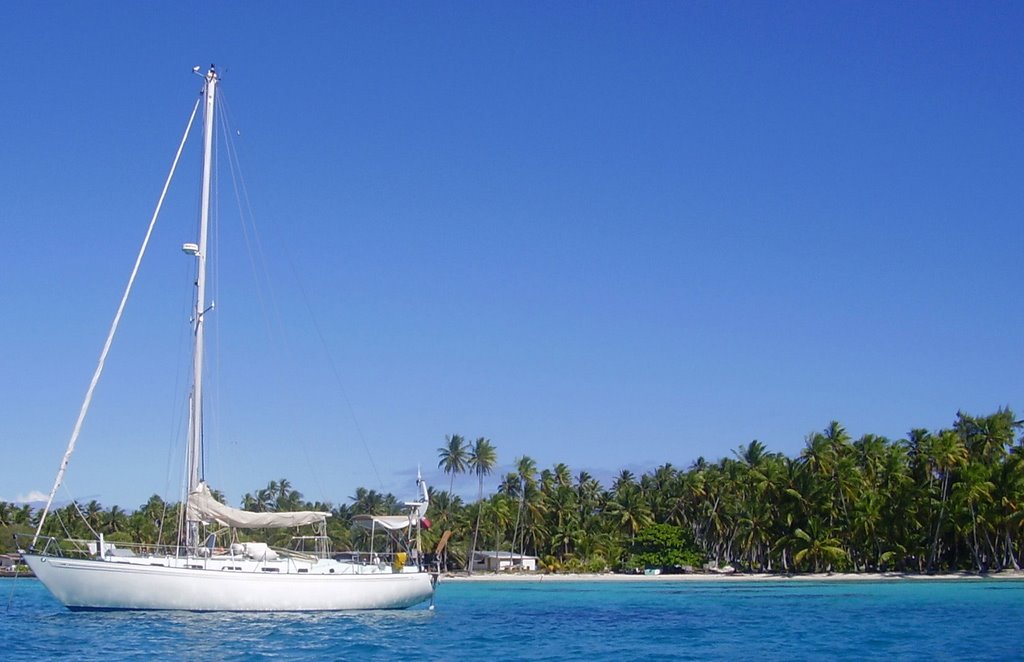
We're currently anchored off a motu (small sandy coral islet within the lagoon) in the south of Raiatea with fantastic snorkeling, the opportunity for some spear-fishing (we've checked for ciguatera with a local fisherman), plenty of driftwood for a beach fire and no shortage of hermit crabs for racing. It's going to be hard to drag ourselves away from Raiatea, but eventually we'll head off north to Bora Bora to locate a waiting parcel and sample (according to our pilot guide), "the most beautiful of the Society islands and possibly the Pacific". We'll let you know if we agree.

Tuesday, July 25, 2006

Landfall in Tahiti

Nick woke me at 1am for my watch and as the night wore on the glow of civilisation ahead became stronger and stronger. Not since Martinique had our landfall suggested such a concentration of civilisation, and it was a welcome sight. Surely here we could get some fresh fruit and veg, visit a net cafe and perhaps find a launderette. After sunrise, Tahiti looked very much like a Marquesan island - mountainous, and lush - but it's important to remember that it, like all the Society islands, is surrounded by a barrier reef. It's a 'melange' (my new french word) of the Marquesas and the Tuamotus. As we motored inside the reef, toward Papeete, we had to dodge fishing boats, water skiers, leisure boats and jet skis. This place is a major tourist spot and the quantity of yachts in the anchorage reflected this.
Return to civilisation

We spotted Zeferin and dropped anchor in a space behind her at about noon ship's time. We have heard and read much about Tahiti, particularly Papeete, being crowded and unfriendly but when we visited the town this afternoon, we liked what we saw and were pleasantly surprised by how helpful the locals were. It is extremely expensive however, and though there is internet access and a laundry, the cost makes us think twice about using the facilities. We have yet to see the fresh fruit and veg but we live in hope. It is Sunday after all.

The anchorage is within the reef and though it's busy, it is very comfortable. The water is amazingly clean. We are anchored in 15 metres and can see the bottom. We have spent some time this evening catching up with Zeferin and swapping coral stories. Joan and I also compared 'no-no' scars - it seems they found her as tasty as me!

Saturday, July 22, 2006

Fakavara

We're off to Tahiti to sample "big city" life and restock the stores. It's approximately 230 nautical miles from Fakarava to Papeete - the capital. We cleared the Fakarava lagoon pass at 11am (Friday), so we should be in Tahiti early Sunday morning.

We'd planned an earlier departure, slack water was at 9am, but we were foiled when only 10m of the 70m of chain we'd put out came up before the chain was taut vertical to the bottom. We'd decided to anchor in deeper water (17m), in the mistaken belief that there would be less coral growth at that depth. It seems that our chain has an affinity for coral and had once again tangled itself around some growth. We tried the brute force method with the engine which only resulted in dipping the bow and creating some alarming noises from the chain. Now the disadvantage of anchoring in deeper water became apparent as we pondered how to free ourselves. Our anchoring spot had visibility of around 6m, that meant diving 11m down just to see the chain. Four attempts later (with long recovery periods in-between) and I finally spied the chain wrapped around the only coral growth in-sight. Now we knew which way the chain was tangled it was relativity straightforward to motor round and disentangle ourselves.

As we hoped, the diving in Fakarava was spectacular. We dove just outside the pass with outstanding visibility. For one of the dives we descended to 30m, circling down quickly to avoid loosing each other in the swift flow through the pass. At the bottom we grabbed onto a rock to hold ourselves against the current, regrouped and stayed in position for 5 minutes watching the 40 or so circling sharks and all the time trying to relax so not to use all the air in the first few minutes. Then we were off, being swept along by the current through a coral landscape, populated by more sharks, tuna, barracuda, and a myriad of reef fish, before dipping down again into a canyon full of sheltering fish.

On the way back from the diving, someone spied a large fin, which our dive boat altered course towards. It turned out to be a 2m tiger shark devouring a dead cat. Our fish identification book's entry for tiger shark reads: "The most dangerous tropical shark, responsible for many fatalities", whereas the reef and black-tip sharks we'd been diving with are merely, "generally timid, but considered dangerous" & "potentially dangerous". I forgot to mention that Ellen was on shark lookout as I dived to free the anchor chain.

We're still canvassing opinion on what to do about the reef damage we suffered. The current consensus is that we might as well wait and take advantage of superior facilities in New Zealand. We remain very thankful for the thickness of Kika's hull - but we don't intend to test it again!

We've re-learnt some useful lessons from our brush with the reef in Raroia, such as being prepared to clear out of an anchorage as soon as the wind shifts and the anchorage becomes exposed - especially if there's a coral lee-shore, and thinking for ourselves and finding our own anchorages rather than relying so heavily on information in the pilot guides; there was much less coral in the second anchorage we found.

Fakarava was a good place to convalesce after the excitement of Raroia and we've made a full recovery, although close encounters with coral heads still loom large in my dreams.

Wednesday, July 19, 2006

Sanctuary in Fakarava

As in Raroia, we reached Fakarava at exactly the right time - slack water - and we sailed through the pass into the enormous lagoon (30x50 miles). We were happy to see other masts in the anchorage and a good stretch of coral free water to drop anchor in. Then it was my turn to inspect the damage to Kika's hull - something I had been absolutely dreading. I was astonished to find only superficial, localised scratches rather like the scrapes you make accidentally when you're preparing the hull for anti-fouling and get a little too enthusiastic with the scraper (or am I the only person that does that?). I can't believe that after all the sickening scraping noises, and the violent series of impacts we suffered on the coral this is the result. I feel a bit of a fraud and can only assume that the coral came off much worse.

Kika is certainly living up to her reputation as a safe and robust vessel and we feel a little humbled by her integrity (not to mention a little grateful). So, things do look much better than we initially thought, but as we're amateurs at diagnosing hull problems we are going to have her hauled out as planned, get confirmation that the damage is only minimal and then put it right.

Meanwhile here in Fakarava we are enjoying the delights of a more sheltered and spacious anchorage and really using our experience to make better decisions when it comes to choosing where to drop the anchor.
We were both a little shell-shocked and exhausted during the passage here so we're having a bit of a lazy day, and then going scuba diving tomorrow.
Fakarava's reputation as a fantastic diving spot is legendary, so be prepared for some fishy tales in the next instalment.

Monday, July 17, 2006

Raroia: the best of times and the worst of times

We were really enjoying Raroia. There wasn't much ashore, a small village, population approx 80, but there was a lot of activity; fishing and pearl farming, spear throwing contests, volleyball, football and general hanging about especially around the ever active barbeques. Not to mention we were the only yacht in the atoll - which gave us a certain novelty value; we'd made an effort to visit one of the less frequented islands and escape briefly from the main yacht route from Marquesas to Tahiti. We'd met a few locals when they'd asked if we had any MP3 music they could copy onto their iPods. Ellen was a little envious as they had super-slim iPods unlike her earlier model. Amazingly they seemed to enjoy our music collection, although discerningly chose mainly from Ellen's library which I guess, won't come as a surprise to some of you.

Even though we were surrounded by fish, we were reluctant to try to catch any as we we'd heard ciguatera (fish poisoning) was prevalent in the lagoon. As we finished the last of our tuna, it was starting to looking as though we'd have to be creative with our surplus of onions, pasta and cans of tomatoes. Fortunately we were saved from the remains of our stores by the offer of an afternoon's spear fishing.
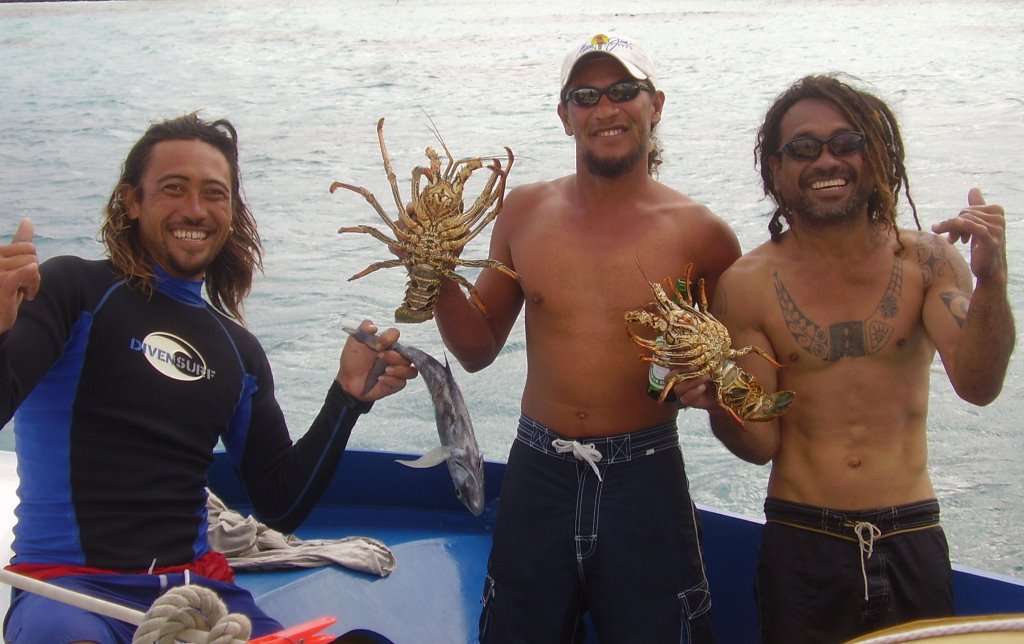
Five of us headed out in a fishing/speed boat initially in search of lobster. Much grovelling around in holes in the exposed coral later and we had two good sized lobsters in the boat. Then we moved to the pass for the spear fishing. It was a revelation; our hosts effortlessly descended, slowly took aim and without fail brought up their speared fish to the waiting boat. My efforts were sad in comparison; vigorous thrashing around as I dived down, by which time I'd expended too much energy, so I only had enough time for a hurried aim at the now rapidly disappearing fish, followed by a swift ascent and a good few minutes recovery. The result - I'm still looking forward to spearing my first fish, but at least I now know what I'm 'aiming' for.

We invited our new fishing friends back to Kika and good evening followed, despite conversation slowed by frequent recourse to the French dictionary.
However during the evening the wind changed direction to the east and increased, exposing the anchorage to the 6 mile fetch across the lagoon and meaning we were anchored just off a lee shore. Our fishermen friends assured us that the wind would soon drop, which initially proved true.
However by 10pm the wind returned strongly, but the anchor seemed to be holding so we turned-in for the night. Just before midnight, after failing to sleep as we listened to the sound of the chain grating on the bottom, we heard a new noise, not coming from the anchor chain but from Kika. The anchor had dragged and we were grating against a coral head. We quickly started the engine and tried to motor forward, but the anchor was wrapped around some coral and the chain was straining at right angles to the bow, preventing us from motoring clear. Our movement was restricted and wherever we shone the torch we could see coral. There appeared to be no way clear. As we pitched in the waves we could hear and feel the coral scraping the keel. We decided the only thing to do was to ditch the anchor, break free and try to get out into open water as best we could. Ellen helmed using the engine to try to keep her off the coral but it was impossible. I set about jettisoning the anchor and chain. It seemed to take forever but eventually we broke free and then tried to find a path through the coral heads with the torch. It was a nightmare - we'd dragged through the anchorage and into a maze of coral. The sound and feeling of her hitting the coral, the screaming of the engine, the howling of the wind, and the beeping of the depth gauge telling us we had no depth, were sickening. At one point, Kika was leaning over with her port side on the coral and we were completely grounded, but eventually we worked our way clear. I checked we weren't taking on water - thankfully the bilge was as dry as normal, although I gave myself a fright when I saw what I took to be oily bilge water on the cabin sole and suspected the worse; thankfully it turned out to be a peach cordial bottle rolling around and leaking its contents. Then we settled down to a night of motoring slowly between two lit navigation marks which we knew where in safe water. Our two spare anchors were on standby in-case the engine faltered but in the event our trusty diesel clearly recognised the severity of the situation and behaved faultlessly.
With the arrival of dawn our priorities were to inspect the hull and retrieve the abandoned anchor. We waited for a let-up in the weather, but with no let-up and no alternative sheltered anchorage we felt we had little option other than to continue motoring back and forth between the two marks hoping for a clear break. Our spare main anchor comprises of 20m of chain and 40m of nylon rode. We were concerned that if we re-anchored in our former spot the coral would make short work of the nylon and we'd be fighting to save Kika again. Fortunately the clouds briefly lifted and enabled us to con for alternative anchorages. We spotted one in the lee of a large patch of coral, which appeared to have a sandy bottom and was further off-shore, giving us longer should the nylon rode chafe through.
Finally, after 12 hours of motoring back and forth, we re-anchored, holding our breadths until the anchor had clearly taken. We still didn't feel terribly secure; we were pitching and jerking horribly on the anchor line in the nasty short chop created by the 20-30 knot winds. Then the moment I hadn't been looking forward to - diving in to inspect the hull. There are plenty scratches and a few gauges below the water-line, the rudder has a few scratches but there appeared to be no structural problems which would stop us leaving the atoll.
Then to recover the anchor. Ellen waited on Kika monitoring our spare anchor, ready to motor clear should it fail, while I headed off in the dinghy towards the buoy I'd attached to the end of the chain. It was hard work recovering the ground-tackle. The chain was wrapped in a figure of eight round a couple of coral heads fortunately and unfortunately shallow enough to easily dive and free. Eventually 75m of chain and our 45lb anchor were in the dinghy, which was now overloaded, making the return journey difficult as the surf threatened to overwhelm our normally dry inflatable. By the time I'd made it back to Kika, the dinghy was worryingly awash, but it was starting to look like the worst was over.
At 4pm we cleared the churning water of the lagoon pass, hoisted the sails and cut the engine - it was such a relief to be back in deep water, enjoying the wind, not dreading it.
We're off in search of a more sheltered anchorage, in another atoll - Fakarava, where we'll rest and plan our next moves. We'll almost certainly take advantage of the haul-out facilities in the Society Islands to restore Kika to her former self and we're both still trying to make sense of what's happened and what we could have done differently.

Final thought: the expression - "you're in deep water" - isn't normally a place you'd like to be; for us it's a joy.

Friday, July 14, 2006

Black Pearls, Grey Sharks

This landfall was a real challenge for us. With tide and light quality to consider, the window for entering is quite narrow. There is also the problem of low-lying land and submerged coral reef to add to the stress and strain of stopping here. Anyway, Nick timed last night's passage brilliantly and we arrived at Raroia at slack tide when the sun was rising. As it turned out the buoyage here is pretty good until you get to the actual anchorage where scattered coral patches make dropping your anchor a little nerve-wracking. After much deliberation we found our spot and were greeted/threatened by 5 small sharks swimming round the boat. Apparently there are many sharks in this lagoon but they're not interested in big game! Hmmm, not sure what I think about that yet. I may have a swim tomorrow, the water is certainly very inviting and of the clarity we haven't seen since the San Blas. At least I can see those man eaters coming!

We are the only boat in the anchorage which is a little surprising as we had had a tip off about the Kontiki Raft returning here for a festival on Bastille Day (tomorrow) and we expected a crowd. Alas the raft has been and gone and is now in Papeete probably with all the other cruisers.No matter, it is well sheltered here and the locals are friendly and interesting so we are quite happy. Black Pearl farming is the main industry and a boat full of young, handsome farmers came to introduce themselves this afternoon and tell us a little about the lagoon. There is ciguatera on the western reef which basically means any fish caught near it is inedible. Ciguatera is a toxin found in marine plant life which accumulates in the flesh of reef fish and their predators. Strangely, it is harmless to the fish, but can cause a severe reaction in humans. It cannot be smelt or seen in the flesh of the fish so it is best not to take a risk. The rule of thumb is to eat small, young, herbivorous fish or best of all, leave off the seafood until you get out in the ocean once again where the pelagic fish are ciguatera-free. Speaking of which, we caught a large tuna yesterday and have just enjoyed our 4th meal from it. We were both overjoyed at catching our protein fix.
Tomorrow for me is going to involve more sewing. The spray hood (which I repaired 4 days ago after someone leant very heavily on it!) suffered a bit of a blow-out during a particularly violent squall on our way here and needs urgent surgery. Nick is going to be helping the pearl farmers expand their music collections by copying our music library for them (after asking us where we came from, they wanted to know if we had an iPod and a computer and could they have some music?!). Nick is hoping that in return he may get a lesson in spear fishing from a professional, as so far his spear gun hasn't speared a sausage!

Thursday, July 13, 2006

Towards the dangerous archipelago

The first couple of days out of Nuka Hiva we enjoyed some of the smoothest sailing we've had to date. So much so that we instigated a film night - with the laptop playing DVDs at the top of the companionway while we watched from the cockpit - the sea was calm enough to remove the worry of breaking waves or sudden rolls harming the computer. However by the second night we'd entered a area of squally, showery weather with Kika alternately over-pressed, or crashing around in the calm which followed the squall. It made for a hard, wet night of reefing, unreefing and hand-steering. One compensation is that there's a full moon at present, so at least we can see what we're doing.

After the squally night the weather moderated, with the squalls becoming less severe and the "calms" bringing sufficient wind to keep the sails full. Last night we were less concerned with the variable wind than with passing safely past the "Iles du Desappointment" - the Admiralty chart and electronic charts disagreed by 5nmiles so we picked the most pessimistic and added another 5nmiles. The wind had other ideas and we were kept busy tweaking the self-steering and sails so that by dawn we'd changed from sailing a fine reach through to a dead run to ensure we didn't make an early unexpected landfall.

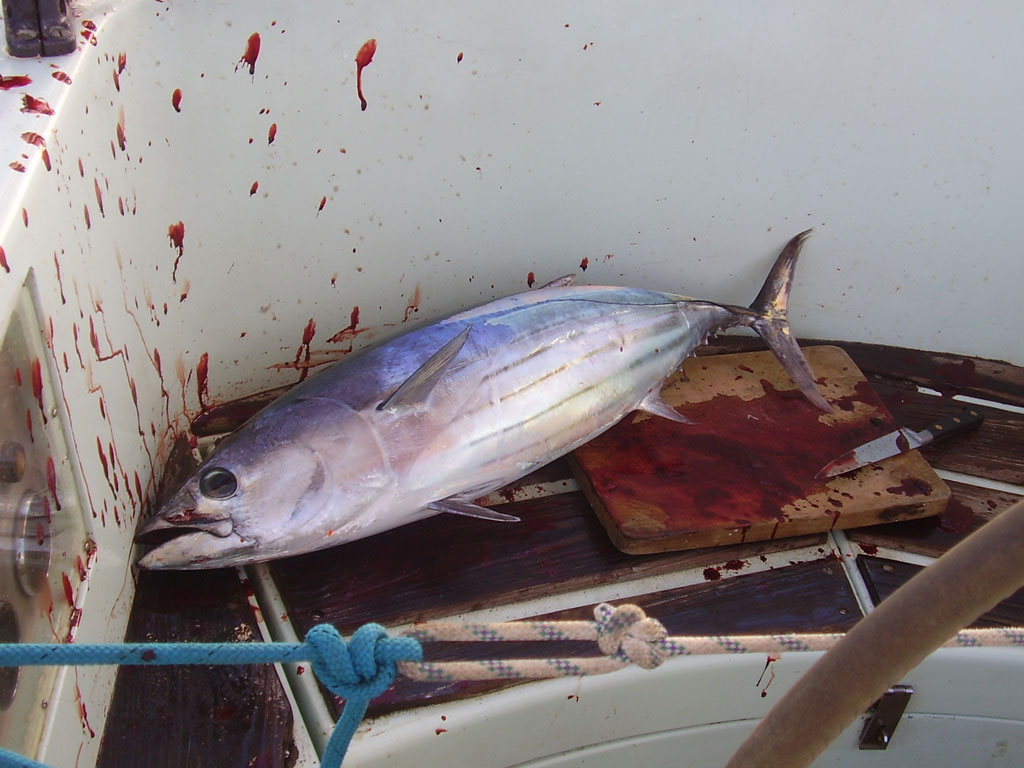
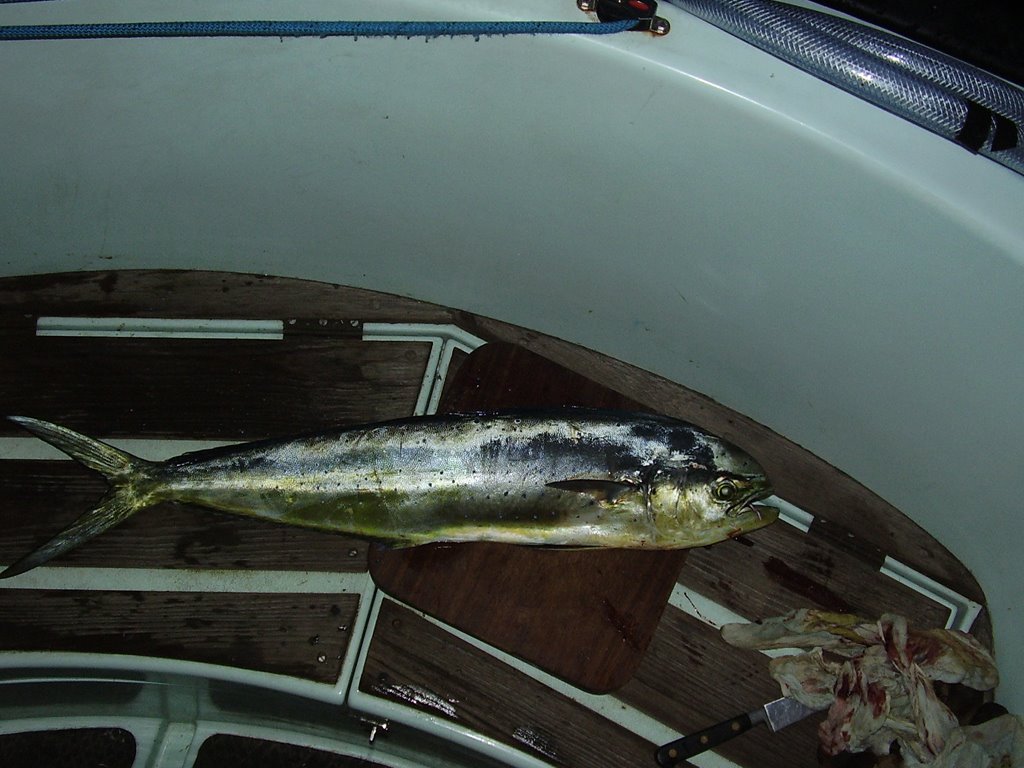
We've been craving fresh-fish and clearly still haven't fully grasped all the skills required, as we'd been unsuccessful so far. This morning I set the line, more out of routine than expectation, but 30 minutes later the scream of the winch as the fish took the line, alerted us to our first bite of since we left the Marquesas. After some effort we landed a fat 75cm tuna and the fridge has once again something to do.


We hope to make landfall at first light. The pilot guide says, "these islands have with truth been called the low or dangerous archipelago. This derives from their low-lying character, only becoming visible from the deck of a yacht when as close as 8 miles". GPS has eased concern about fixing our position accurately, but many charts of this area were made before GPS so we still need to be vigilant. The other complication is that many of the passes are small, and have strong tidal flows through them; they act as a funnels, concentrating the flow of water into and out of the lagoon. High water is at 0715 local-time so we aim to enter a little before that, to catch the last of the flood. If we miss morning high-water, depending upon conditions we might have to wait outside until low-water - 1.30pm. It all makes for a slightly more challenging landfall...
Position at 1640 (GMT-9) S14deg 52.7' W142deg 01.6'

Monday, July 10, 2006

South to the Tuamotous

Time to move on again. We left Nuka Hiva yesterday morning for the Tuamotus. We're aiming for Raroia which is where Thor Heyerdahl's raft "Kon-Tiki" was stranded at the end of his voyage from Peru. We're hoping to arrive in time for Bastille day (14th July), which is the excuse for major festivities throughout French Polynesia.

We've had a slow, if relaxing start, with a gentle 10 knots of easterly wind and calm sea. If the wind shifts more to the SE, we might struggle to make Raroia, but there are plenty of other islands to choose from, the pilot guide says there are 78 atolls within the archipelago, stretched across a 1000 miles. Thankfully it isn't possible to visit them all; the French used some of the southerly atolls for their nuclear tests, and others are only navigable by shallow draft boats through small breaks in the reef. Still lots to look forward to, with clear water, fantastic diving, snorkeling and fishing opportunities.

Since the last update the roaches have vanished, we hope permanently, but suspect they will reappear once the eggs hatch.

We stayed a few extra days in Ua Pou as we'd learnt that the bamboo, palm-leafed and corrugated iron buildings taking shape around the waterfront would result in a festival area opening on 1st July. The fete opened with speeches in Marquasian and French. Embarrassingly my school French only allowed me to deduce the occasional word and the only real thing we learnt was the correct pronunciation of Ua Pou - "Wah Poe". Eventually the speeches gave way to food, booze and dancing, all of which we indulged in.

The following day we left for Nuka Hiva, taking our time to extricate ourselves from the breakwater - we hoped a friendly local would untie our shore lines, but with little Sunday morning activity we resorted to juggling, retrieving the anchor while swimming to the breakwater to free our lines, surprisingly the plan worked out and we set off for Nuka Hiva, expecting a pleasant day sail. Unfortunately a nasty cross swell and a couple of squalls meant the trip was more of an endurance test or perhaps our week in Ua Pou had softened us, whatever the reason we were glad when we made the shelter of hills surrounding the main town in Nuka Hiva - Taiohae Bay.

It was the biggest anchorage we'd visited in the Marquesas and it came as a shock to see so many boats, although great to catch up with friends, particularly Pepe and Bianca, on Argo. Our paths have been crossing since Venezuela and we'd last seen them in the Galapagos. Argo has no HF transmitter so we'd lost touch. They'd only just arrived in the Marquesas and were still relieved to be safely at anchor after suffering from a broken engine and shredded sails during the last part of their crossing.

We spent a couple of days in the main town becoming accustomed to roads that allow cars to make it out of second gear, scouring the local shops for vegetables (we found two cabbages and three carrots which between them cost an extortionate $10US) and enjoying the slightly more developed facilities - two restaurants and an internet cafe.

From the main town we headed three miles west to a secluded anchorage known as Daniel's bay, which surprisingly was completely deserted. The bay is named after the former inhabitant whose dwelling overlooks the anchorage. There's a sad story here; the American reality TV series "Survivor USA" based a series in the bay, and moved the elderly Daniel to new house in another bay. The island rumour was that he never recovered from the move and died the week before we arrived.
The bay would have made a perfect setting for a Ransome-esque story:

'"Hello" called out the explorers, trying to get a response from the deserted buildings. It was most eerie; clothes hanging on the line, a radio playing, but no-one around. "Perhaps he forgot to switch off his radio when he set off for work", said Susan sensibly, "Perhaps he's been kidnapped", said Roger, just then John called out, "native foot-prints on the beach, leading to a neat pile of bones". "Cannibals" cried Roger....'

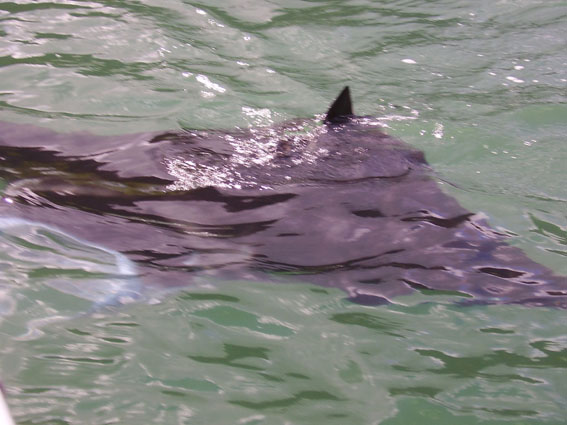
The wild-life in Daniel's bay was spectacular with boobies startling us as they dived around the boat and a couple of impressive manta rays swimming in the bay and coming right up to Kika before diving under her.
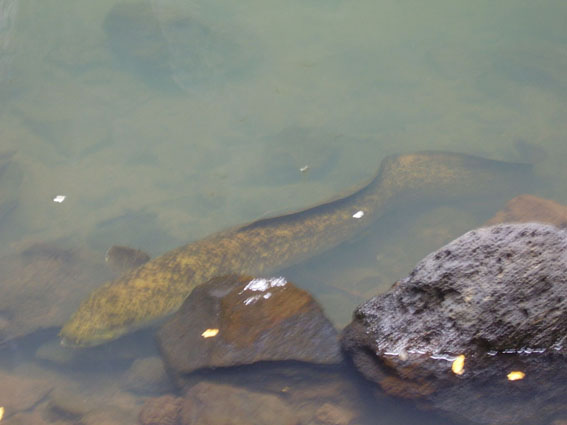
We also caught sight of the massive eel which inhabits the pool under the local waterfall - he was impressive enough for us to skip the swim.

Unfortunately there was a downside to anchorage, in the form of no-nos which attacked us relentlessly. Ellen was particularly badly bitten, and currently requires twice daily applications of calamine lotion to ease the itching. Encouragingly other cruisers say the bites completely disappear after 4-5 days. We're on day 3 and looking forward to being itch free.

We headed back to the main anchorage to escape the no-nos. While Ellen settled down for a quiet night on the boat, nursing her bites, I headed off with other cruisers to the Saturday night entertainment - the Miss Nuka Hiva 2006 competition. Sadly my choice of Nika Hiva's finest only came 4th, although she took it well still smiling radiantly while supporting an elaborate head-dress of palm fronds.

On the technical/boat maintenance front we seem to be on-top of things. We've patched the spray hood which split when it took my weight as the boat lurched while I was securing the main. The rat-lines are slowly making their way up the shrouds, thanks to Will (from Ragtime), gifting me a serving mallet and teaching me how to use it.
I've also further diagnosed the engine problems we had on the last day of the crossing which I now think might be related to the engine stop cable intermittently sticking between closed and open and starving the engine of fuel. Long may it last....

Friday, June 30, 2006

Pests and pitch-poling

Our stay in Hanamoenoa Bay on the small island of Tahuata was tranquil. There was no settlement, just a beautiful beach, coconut palms and lemon trees. We had a great overnight sail there punctuated by a dolphin visit and something sinisterly large on the fishing line which, having made the winch scream with the speed of the racing line and created an impressive bow wave behind us, thankfully, got away. In the bay we spent a couple of days snorkeling, reading and doing a few 'low-level' jobs. We were 'friendless' in the anchorage when we arrived, with 5 unknown boats there, and it was a good opportunity to meet some new people after the easy security of 'the Net' group. Sadly but inevitably the group has now dispersed but will reconvene at intervals along this 'Coconut Milk Run' route.
We headed for the larger island of Ua Pou overnight on Saturday and had a challenging time anchoring in the roly bay. Several friends had suggested that because of the swell that enters the bay, a good idea would be to put the anchor out and secure a line from the stern to the breakwater to give us more stability during our stay. We don't love Kika for her manoeuvrability - she is famously awful at going astern - so we were apprehensive but nonetheless determined to rise to the challenge. All the other boats in the anchorage had stern anchors out and were rolling, a further inducement to secure to the wall. So we waited for the wind to slacken off and then went for it and Kika behaved impeccably, reversing beautifully and rather haughtily into position when Nick had dropped the anchor. We felt quite smug ('specially me, I was at the helm!)Something we're not so smug about are Kika's 'visitors'. We have an infestation of cockroaches which is quite revolting and upsetting as they are something every cruiser dreads for their sheer numbers and tenacity. In fact, having roaches is quite taboo amongst the cruising fraternity which stops short of flying a flag signalling your shame, but we agreed that the blog should not be censored, and you, as readers have heard plenty of the good stuff, so can share the bad. Anyway, it appears our 'lodgers' are a sort of super-creature whose powers of survival are limitless. They can stowaway as eggs in the gum of cardboard, or under your shoe, or they can simply fly in through a hatch if they fancy emigrating. Once aboard, they are difficult to kill, and when you have managed to do so, their eggs lie dormant for a while and then the new batch begins! So chemical warfare ensued aboard a couple of days ago. Having realised that spraying was having no effect except possibly making them bigger and bolder, we invested in some Aussie stuff with 'Egg Kill' that zaps them and apparently the eggs too. Lockers have been disinfected and 2 types of poison added. All we can do is wait. Nick is not too bothered by them and really, they aren't that harmful, but having 'fessed up to my parents about this current challenge, Dad did a 'Google' search and helpfully informed me that they like to nibble on human eyebrows! Words fail me. Where's that flag, the one with the black cross on it?

Another disaster befell us the afternoon of our arrival. As I said, the anchorage is roly and suffers from cross swells which can make landing a dinghy difficult (you know what's coming, don't you?). Well, we rowed Jordan to shore but were pitch-poled at the last minute in the shallows. It all happened very quickly and was quite dramatic. I was thrown out of Jordan and dragged under the surf, while Nick was completely engulfed by her as she pitched over. I stood up, to see the upturned Jordan and not a sign of Nick. I had images of him unconscious and water filling his lungs which was enough to give me cockroach super-strength and I lifted up the dinghy (no mean feat - she's a big girl!) to find 'no-mercy' Nick unharmed and ready to spring to action. All was salvaged including 4 flip-flops, 2 pairs of sunnies, 2 oars and the plastic dinghy seat which had given me a glancing blow on the cheek as it flew off into the surf. Jordan, however, is now on probation. Brenda is ready and waiting in the forepeak if we have any more nonsense! Thankfully, Nigel was not involved as we had decided to row in. Phew!

Oh well, we have had some fun too; hiking in the hills, relearning how to spend money in shops and bars and, of course, since there seem to be no laundry facilities for yachts in the islands, doing plenty of washing. We knew the pressure cooker was a wise addition to the galley, but it also gets your whites whiter (well, sort of). Our walk was breathtaking and we were accompanied by Patrice who was refreshingly modest about his knowledge and experience of being a guide and encouraged us with our attempts at French, the common language. We came down from the mountains with aching legs, an enhanced French vocabulary and backpacks full of fruit, fruit, fruit.

-------------------------------------------------

Wednesday, June 21, 2006

Dreams

For years I've read about the Pacific islands and always dreamt that one day I'd sail across the Pacific to arrive at one of the exotic destinations I'd imagined. Reality has lived up to the dream. The anchorage in Fatu Hiva is the most spectacular anchorage I've ever woken up in.

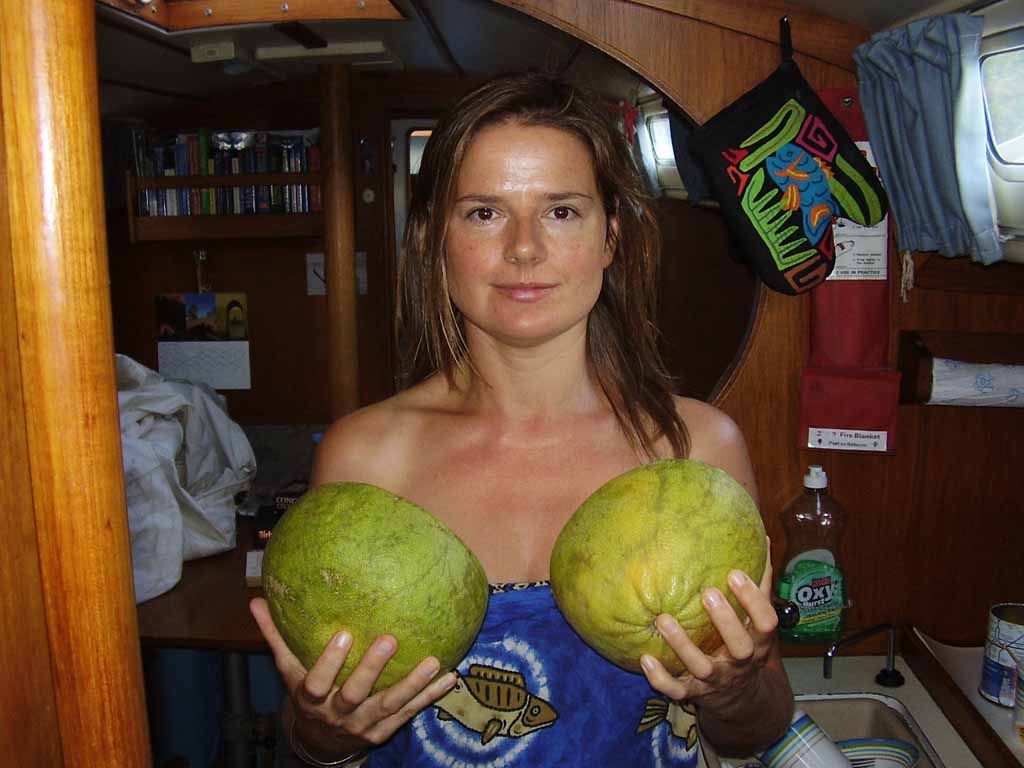
Ashore the trees appear overburdened with fruits - I've never seen such enormous or deliciously sweet grapefuits before. We exchanged two lipsticks for six grapefruit and a bunch of bananas.


The next day Andrew and Carolyn on Revision II arrived, followed in the evening by Will and Alyssa on Ragtime. Joan and Sandy on Zefferin invited us all around for a celebration supper, during which we nobly helped them make some inroads into the large wahoo they'd caught just before arriving.

There's no airport on Fatu Hiva, so the only tourists the locals see are passing yachts. It's a small habitation in a valley between vertiginous rocks all carpeted in lush vegetation and coconut palms.


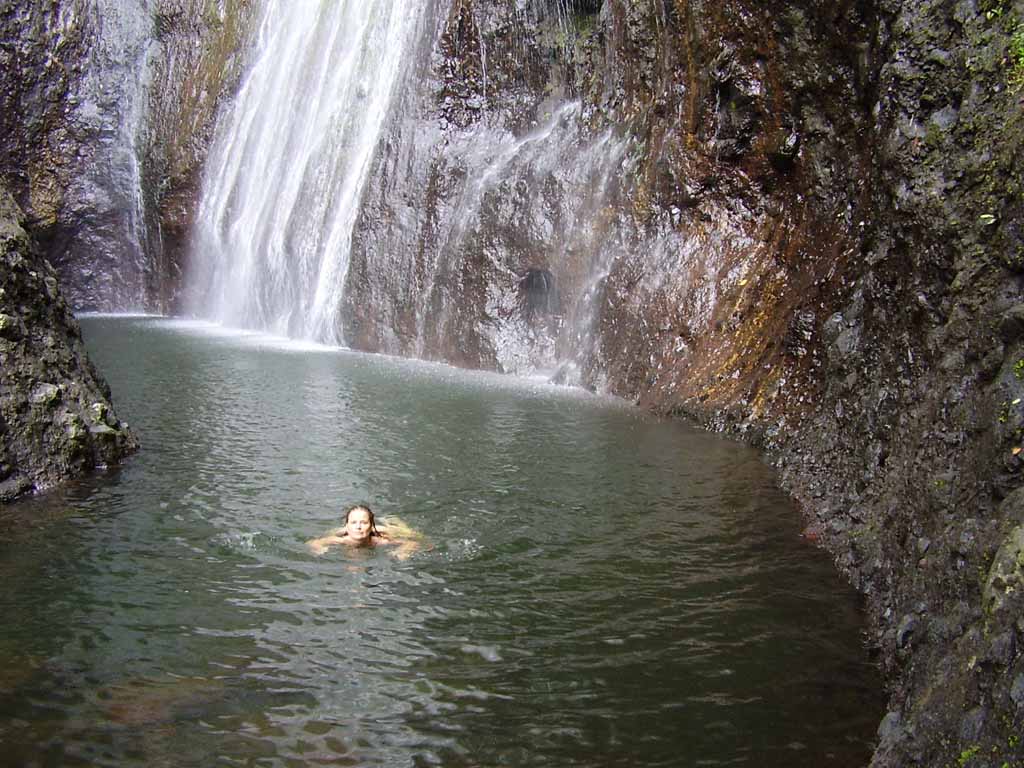
We've taken a couple of hikes, firstly up a winding road to a hill overlooking the anchorage from there we spied a waterfall emerging from a dramatic cliff face in the distance and made our way through dense undergrowth to the pool under the fall.


All the time we had the place to ourselves and used the pool for our first bath for months, avoiding the small clawed shrimps who tried to give us the occasional nip.


The only downsides we can see so far, are the insects, we had a couple of hornets checking us out and the abundant vegetation comes at the price of occasional torrential downpours.

Yesterday was spent with the most pressing boat jobs - the tanks are full of fresh water again, the main sail is repaired and the hull clean after growing some almost edibly large goose-necked barnacles on the passage.

We set off at 8am this morning for Tahuata, a small island 45 miles NW of Fatu-Hiva. We plan to stay a day or two there before heading on to Ua-Pou, a port of entry, where we'll arrive officially.

The sailmail connection in the anchorages is almost impossible; the surrounding mountains shield our signal. On open water, getting a connection is a challenge as well; the coverage in the Pacific isn't great, our nearest station is Hawaii 2210 nautical miles away, or US based stations 3000+ nautical miles away. So our entries might become a little more sporadic from now on. We have lots of photos, just waiting for a fast internet connect to be able to upload them.

Monday, June 19, 2006

Landfall

Yesterday seemed to drag on for a week in contrast to the rest of the trip. We decided that although there was minimal wind in the afternoon, we'd attempt to sail with just the genoa (we'd taken the main off for repair) and I'd helm while Nick changed the fuel filters as we suspected dirty Panamanian fuel was causing the engine to run erratically. It was impossible to keep the genoa full and it flopped about and flogged against the rigging in a maddening fashion. Also, without the main we were rolling like crazy. In honour of approaching landfall, we both had a saltwater shower in the cockpit earlier in the day, and I had recklessly cast off my 3-day old, manky anti-sickness patch thinking I would manage without one for the last leg - wrong! Consequently I felt sick most of the afternoon.

Nick completed the filter changes despite the roly-poly conditions and we furled the genoa and fired up the engine. According to our GPS we were still about 35 miles from land. We hadn't been able to make out the island amongst the low cloud until then but gradually, Fatu Hiva took shape in exactly the place it should be. I went to sleep in the evening and having slept off the sickness was woken at about 23.30 by an excited but tired Captain. We were about 2 miles north of the island and in the darkness it was difficult to make out anything but the silhouette of the land. Nick then slept and I spent an exciting couple of hours navigating across the north and down the west side of the island. The moon still hadn't risen and at times I felt very unnerved about my proximity to the coast but it was very thrilling and I used the radar to verify what the GPS was telling me. When I headed south to cover the 3 miles to the anchorage, a little white light seemed to be marking our waypoint exactly.

At about 2am it was time to wake Nick and we both struggled to make out our surroundings. The moon was up by now, but it was pretty cloudy and it took us a while to work out the anchorage was surrounded on 3 sides by tall cliffs with strange formations at the peaks. We motored around as slowly as we could and gradually made out the hulls of 5 other boats and with our super-powered torch we picked out the rock faces and were able to find a spot to drop the anchor, which we did at 2.20am. I had followed that little white light all the way into the anchorage. It was an anchor light - Zefferin's!


We woke early this morning in the most extraordinary, dramatic anchorage we have ever seen. Can't describe it adequately but I'll try. The Marquesas are volcanic but there's hardly any rock visible just numerous shades of green. Some of the peaks are long craggy and vaguely reptilian in their spikiness, where others are rounded like sugar loaves and topped with a hat of bushes! The coastal cliffs are indented with deep valleys and ravines. The highest peak on this small island (8miles x 5miles) is continually covered in shifting cloud.

This morning, we decided to complete the 2 most pressing jobs; cleaning behind the oven (after much sponge pudding and custard spillage) and scraping the propeller, which we checked had solved the speed problem with a quick trip around the anchorage this morning. Zefferin have given us a huge local grapefruit for breakfast, and also an enormous fillet of wahoo which they caught on their approach here and which we are having for lunch. There is a small village here with a church and a school and apparently not much else though we shall explore this afternoon. Trading is the way to do business; a t-shirt for some grapefruit and bananas, some fish hooks for flour etc. Apparently a load of washing costs a bottle of rum so looks like we'll be doing it by hand! Oh woe!

Overall passage statistics
--------------------------
Passage time: 20 days, 10 hours, 30 minutes
Charted distance: 2900
Logged distance: 2862
Total engine hours: 12
Distance to go: 0
Landfall: Hanavave Bay, Fatu Hiva, French Polynesia (S10°27.83' W138°40.08')

Saturday, June 17, 2006

Drifting towards the Marquesas

We'd hoped we'd be making landfall today (Sunday), but our speed has been steadily decreasing as the wind has eased over the last few days. As I write this we have 60 miles left to go. At our current rate of progress we'll probably arrive sometime after dark or early morning Monday. We've been trying various combinations of sails to keep the speed up, including rigging the cruising chute as a spinnaker (moderately successful, but required too much concentration from the helm), moving the pole further back to allow us to have more genoa out - our current setup - it's a pain to rig, requiring forward and aft guys to fix the pole, but appears to be the best current option.

In the early morning when the wind had died completely we gave in and ran the engine for an hour. Worryingly, we couldn't make more than 5 knots, which I assume is because our propeller has become heavily fouled on the trip here, and hopefully not something more serious. We decided that the noise and heat wasn't really worth the extra knot so we're currently trying to do as best we can with the little wind there is.

Another successful fishing day yesterday. We'd put the line out after lunch when we'd finished the last of our previous tuna, and by mid-afternoon we had another tuna in the cockpit. A small yellow-fin tuna this time, which we marinaded and ate half for supper, the remainder we'll polish off today.

No sign of land yet, but we should spy the mountainous Marquesas before nightfall.

If you don't hear from us tomorrow it's likely that we'll have made it, but are struggling to send an email out - we believe that the sailmail reception in the anchorage is challenging.

---
Position @ 21:35 UTC: S10°10' W136°11'
Daily distance run: 130 nm
Distance to go: 148 nm
Cumulative distance: 2708 nm
Engine hours:0
Wind: E 5-10 knots
Weather: moderate/slight sea, 20% cloud cover, 1010 millibars
-------------------------------------------------

Friday, June 16, 2006

Stitch in Time

Day 20 and we do have one ratline up which is looking and feeling very sturdy - a good start! As anticipated the wind has died somewhat and we are prepared for the lowest mileage of the passage when noon comes. We do only have 270 miles to go though so should be anchored in the Bay of Virgins, Fatu Hiva on Sunday.

Tuna is still on the menu with marinated and baked tuna with potato salad for lunch, and tuna curry for supper. We ate our supper sitting at the bow watching the free entertainment which comprised of about 20 of the most acrobatic dolphins we have seen. We watched them leaping, pirouetting and belly flopping with a breathtaking sunset as their backdrop. Nick left after about half an hour, but I thought it would be rude to go before they had finished! Eventually the sun went down and I couldn't see anything so felt it was safe to leave without causing offence.

Drama came yesterday in the form of sail damage. Our main has a rip going almost the entire length of the foot. Fortunately it is below the first reef, so we immediately put one reef in to prevent further damage and enable us to use it on this last leg. Alas, we will have some serious stitching to do when we make landfall.

----------------------------------------------------------
Position @ 21:03 UTC: S09°48' W134°0'
Daily distance run: 140 nm
Distance to go: 278 nm
Cumulative distance: 2575 nm
Engine hours:0
Wind: E 10 knots
Weather: moderate/slight sea, 40% cloud cover, 1010 millibars

Thursday, June 15, 2006

Fishing success

Great day yesterday. We woke to clear skies, a moderate sea with 15knots of SE wind and good intentions to make progress on the ratlines. However, things don't always turn out as intended...

There was noticeably more excitement on the morning net as boats started working out arrival dates and times. The wind is forecast to ease a little over the next few days so we haven't dared to name our arrival day yet. Our expectations of boat speed have also changed during this passage; now we start to get restless if we're making under 6.5knots, previously we would have been content with anything over 5knots. During breakfast the wind backed to the east, so a good half hour was used up as we changed from a broad-reach back to running down-wind with the genoa poled out.

Then I decided the bimini required some attention, so another hour passed as I attached scavenged lengths of elastic and assorted clips to our new side-shades.

Finally I sat down to study the impenetrable rigging handbook's advice on constructing ratlines, while Ellen set about baking carrot cake. An hour of study, searching for materials and a some dozing later and I was ready for action. Right on cue the fishing-line winch span, indicating a bite. So fish drill - now an orderly efficient process to prepare Kika for the imminent blood bath.


For the first time in days we landed our catch. A beautiful 60cm tuna, who didn't appear to take well to his new surrounding. It's surprising how long it takes to process and clean up after a landing a fish, but there wasn't much time to spare before the afternoon nets, followed by supper, all punctuated by breaks to sample the delicious carrot cake. We've a good few days' tuna in the fridge, but no progress on the ratlines, perhaps tomorrow...

-------------------------------------------------------
Position @ 20:48 UTC: S09°20' W131°42'
Daily distance run: 162 nm
Distance to go: 418 nm
Cumulative distance: 2435 nm
Engine hours:0
Wind: E/ENE 15 knots
Weather: moderate sea, 20% cloud cover, 1009 millibars

Zefferin take the lead

We spoke to Zefferin early this morning and discovered that our paths had crossed in the night and we were now too far south and east of them. We continued to try to converge during the morning, but our fixes were no closer at midday so we decided that though it would have been fun, a mid-ocean rendez-vous was not meant to be. We should see them pretty soon in Fatu Hiva anyway. We never managed to speak to them on the VHF and we never saw their nav. lights. Hmmm.........are Zefferin really on passage, we ask ourselves or are they still enjoying the Galapagos? We would wonder if it wasn't for Revision II whom Zefferin met up with about a week ago.

Meanwhile we are passing milestones rapidly with under 500 miles to go now. We celebrated this by sharing a cold can of beer at lunchtime. The weather has been perfect all day; a consistent south easterly wind of about 20 knots, big, thrilling sea and a cloudless sky. It's like a different world from the squally mess we were trapped in a couple of days ago. All is well within the flotilla though most of us sound well ready to make landfall. If we keep up our speed and arrive on Sunday/Monday, this passage will have been considerably shorter than the Atlantic crossing despite it being a thousand miles longer - it's amazing what a consistent wind can do.

Fishing update - several bites but all got away AND we lost another lure! Reckon a) we're going too fast and b)we're hooking some big fish which are too strong for our equipment. We don't want to catch anything too big because it would be difficult to dispatch and the meat would be wasted as we don't have a freezer, so we're reluctant to upgrade the line.

---------------------------------------------------------------
Position @ 20:35 UTC: S08°39' W129° 03'
Daily distance run: 151
Distance to go: 580
Cumulative distance: 2269
Engine hours:0
Wind: SE 15-20 knots
Weather: moderate sea, 0% cloud cover, 1010 millibars

Wednesday, June 14, 2006

Return of blue skies

We woke up to blue sky this morning, our first for three days and the weather made good its early promise with sun and clear skies all day. The wind has remained fresh, 20-25 knots with occasional gusts up to 30 knots. We're making good progress on a broad-reach under heavily reefed main and genoa. We've thoroughly tested the cockpit and deck drains with some big waves breaking onto us - they work, with Kika taking it in her stride, initially laden with water, but quickly shaking it off and continuing on her way. Given the size of the sea it's surprising how few waves we've taken over the side. That said the sailing hasn't been too taxing, with George in control all day and working well under trying conditions; bringing us back onto course after being pushed off by a passing monster wave.

Zefferin continue to close on us and as of last night was 7 miles behind us. We still haven't actually seen them, but we thought at nightfall we'd be able to see each other's mast head lights, but no sign of them yet - a bit concerning because I've always assumed the mast-head light would be clearly visible to others, perhaps not in a large sea. We've talked to Zefferin a couple of times today, the conversation punctuated by "oh my God, that was a big one", "hang on, oh ah, yes, um, back again, self steering just lost control" and other stronger expletives. Either our conversations happen to coincide with Zefferin passing through some especially rough water, or they appear to be having a wetter time of it than we are. Schadenfreude? maybe a little.

Despite the rolly conditions we've been working on the bimini to try to improve the water catching system. After spending an hour extracting the sewing machine from its locker and tying it securely to the saloon table, I discovered that it's too feeble to sew through five layers of Sunbrella material. So untie, restow and out with the patented hand-stitcher, which when we first bought it, seemed to be a marvel of design simplicity. However after a couple of rows of meandering stitches, I now see it for what it is - nothing more that a handle containing a needle. Eventually the bimini work was postponed when I broke the needle. Hopefully it will resume tomorrow when the glue sets the remaining half needle into the handle.

It's now the middle of the night, the sea has calmed down a lot, but still no sign of Zefferin. It's eery scanning the horizon, knowing there's another boat out there, but not being able to see it. We're hoping for some good photo opportunities tomorrow.
-------------------------------------------------
Position @ 21:20 UTC: S08°10' W126°53'
Daily distance run: 158 nm (estimated)
Distance to go: 731 nm
Cumulative distance: 2118 nm
Engine hours:0
Wind: SE/ 20-25 knots
Weather: rough sea, 50% cloud cover, 1010 millibars

Tuesday, June 13, 2006

Wet play

Another day of squalls and thick grey skies devoid of the promise of better weather to come. I woke with a 'wet play' sinking of the heart. As a teacher, days like today are dreaded because the playground will be off the menu due to inclement weather, and there will be no respite from the children throughout the whole school day! What does one do on days like that? Find solace in the form of food of course. Chocolate fudge brownies for breakfast, hot, wholesome soup for lunch and a big bowl of pasta for supper.

The one redeeming feature of the day was the fact that it was Andrew's (Revision II) birthday and sad though it may seem, we were a little excited because we had prepared a ditty on the trumpet and a poem for him which we broadcast over the SSB during our early 'chat time' with the flotilla. Poor Andrew had just woken up and sounded a bit groggy but very appreciative. George has done another stirling job today, managing to keep us on our rhumb line without too much tweaking. We are now on a port tack and hoping to converge with Zefferin sometime tomorrow though they are taking longer to catch up than we had anticipated. We are going to try talking to them on the VHF as they should soon come into range.

We tried catching some fish earlier in the day and had 4 bites but lost all 4 and 2 lures which was very annoying. Let's hope we have better luck tomorrow. Only 900 miles to go which is about 6 days a this rate, so we could be anchored in the Bay of Virgins, Fatu Hiva, this time next week. Can't wait!

--------------------
Position @ 20:50 UTC: S07°43' W123°52'
Daily distance run: 158 nm(estimated)
Distance to go: 892 nm
Cumulative distance: 1951 nm
Engine hours:0
Wind: SE/E 8-25 knots
Weather: mod/rough sea, 100% cloud cover, showers, 1011 millibars,
frequent squalls.

Monday, June 12, 2006

Less than 1000 nm to go

As of 6am we have 933 miles to go. The weather hasn't improved and we're still sailing under heavily reefed sails in strong squally winds. Compared with the effortless 150+ mile days we achieved in the first half of the trip, it now feels as though we've more than earned every mile we make west, with frequent adjustments to the sails and attention to the helm required as we hand-steer through the squalls and lulls. We've tried different strategies; initially we'd reef at the onset of a squall then increase the sail when the squall passed. Inevitably as we became tired we tended to reef too late and ended up slopping around with too little sail up in the lulls. So the next strategy was to sail under reefed sail, but with sufficient sail to keep us sailing through the lulls and hand-steer through the squalls when George (our wind-vane) struggled to keep the course. This worked well, and gave us something purposeful to do but was tiring.

The huge southern ocean swells of yesterday have diminished, leaving a confused sea in the cross-swell, but resulting in more easily steerable seas. So after much trail and error, we've managed to sufficiently balance the sails to allow George to steer through the squalls and lulls. It's a revelation, we're getting good rest, we're racing along in a reasonably straight line without too much rolling and we can marvel at the atrocious scene around us from the relative dryness of the spray hood. Despite the wetness it's thrilling sailing. The large seas of yesterday also brought their own excitement; on occasions we registered 10knots on the log while surfing and hand-steering down the waves. At these moments Kika came alive, feeling as responsive as a high-performance sailing dinghy.

Before the huge swell had subsided life down-below was difficult, the motion of the boat was erratic with extremely violent rolls. Yesterday I cooked one of my infamous treacle sponge puddings and for lunch we decided to have spanish omelette and treacle sponge and custard. What a mess. The poor gimbals on the stove couldn't keep up with the erratic motion with a third of the omelette ending up in a 50cm radius around the stove. The non-slip surface couldn't contain the custard mixing jug which deposited its contents in the condiments locker. Still the end result, although somewhat diminished, was worth the effort.

We spied our first boat of the crossing yesterday, a large fishing boat about 1 mile to our stern, they didn't respond to our friendly VHF calls, perhaps we weren't such a novelty to them.

As of last night Zefferin were 37 miles behind us, they are catching us up, but at a slower rate. Positively, it's proving useful to have someone close who is experiencing the same weather. We compared strategies and wetness - they've given up using their wind-vane and have switched to their electronic autopilot and hand-steering through the squalls.

We're not sure how much longer this weather will last, but while it does we can make the most of it. Tomorrow we're going to perfect the water catching system, Currently the pipe from the bimini leaks, with the leak strategically placed to pour water down the helm's neck.
--------------------
Position @ 22:15 UTC: S07°20' W121° 23'
Daily distance run: 160 nm (estimated)
Distance to go: 1024 nm
Cumulative distance: 1809 nm
Engine hours:0
Wind: SE/E/ENE 10-30 knots
Weather: rough sea, 100% cloud cover, frequent showers, 1009 millibars,
gusts up to 35 knots

Sunday, June 11, 2006

Taxing times

The Pacific has certainly not been living up to it's name today. We have had the first 'wet' day of the trip - almost total grey cloud cover and sustained downpours with all the gusty winds to match. It's the roughest sea and the most taxing passage that I have ever encountered. We are hoping this is not how it will be from now until the Marquesas, but if it is, at least it'll be quick!. Nick woke me at 10pm for my watch and I was greeted by (more) torrential rain, a howling gale and monstrous waves. George the wind-vane was doing his best to keep control, and I reefed the genoa considerably to give him a helping hand (Nick had already put 3 reefs in the mainsail). Our speed dropped 3 knots and peace of a kind was restored.

The whole day has been wet and devoid of any sun apart from an hour at sunset. Heavy rain has prohibited us from sitting in the cockpit so we have been nerding down below and doing the occasional bowt of helming when George has struggled. In conditions like today, I find that there is a fine line between exhilaration and fear, and knowing the right time to reduce sail is imperative as things can so quickly get to a point where reefing becomes dangerous and difficult. The wind is one hazard but the waves are another. They come at us from port aft and can knock us for six making the helmsman's job harder (be it George or us)! Most of the time though, we just get carried along the crest of the wave like a toy boat in a bath, and it's quite good fun. One second we're on top of the world and the next we're in a deep dark trough with a wall of water bearing down on us. It's like a rollercoaster!

We're hoping for a break in the cloud and some more consistent wind tomorrow. Our one consolation is that Zefferin are also experiencing this challenging weather. We are not alone!

--------------------------------------------------------------------------------
Position @ 19:55 UTC: S07°14' W118°27'
Daily distance run: 143 nm
Distance to go: 1214 nm
Cumulative distance: 1638 nm
Engine hours:0
Wind: S/SE/E/ENE 15-30 knots
Weather: rough sea, 90% cloud cover, 1010 millibars, gusts up to
35knots

Saturday, June 10, 2006

Surfing downwind

Last night was more roly than normal, with all the attendant crashes and bangs from the lockers, with the result that the lockers became progressively more stuffed with tea-towels and rags during the night in a vain attempt to calm their excitable contents. Consequently sleep was harder than normal, I'd try to blank out the roll-roll-crash, roll-roll-crash that was keeping me awake, eventually giving in and drag myself out of my berth to locate the culprit. No sooner was I settled down again when the periphery of my hearing would start to tune in to some other loose item crashing around. It must have been noisy as the crashes even penetrated Ellen's ear-plugs. We both managed some sleep, but were definitely a few hours down at dawn.

On my middle watch, I found George the wind-vane, performing a valiant job trying to keep Kika running down-wind as she surfed down the waves. It was impressive watching as the vane turned the wheel one way then the other, as we yawed and rolled through the large sea. I decided to try to improve on George's performance and my tiredness vanished with the exhilaration of hand-steering as we surfed through the seas, often accelerating to over nine knots. Spent a great hour with one eye on the wind-angle, the other tracking the compass and the speed, while attempting to keep a fairly steady course and minimise the rolling. Ultimately I succumbed to my tiredness and let George take over with a much reduced head-sail.

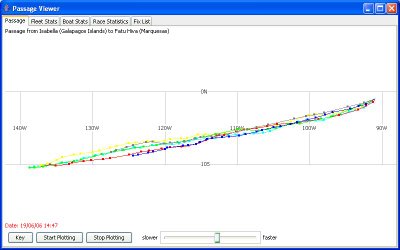
I've completed a little program which animates the courses of our group of boats crossing the Pacific. A by-product is that it's been straight-forward to calculate average daily distances for each of the boats. I'm beginning to understand Peter Snow's fascination with his swing-o-meter, as I compared averages, maximum daily runs and anticipated arrival dates. I'm sorry to disappoint our supporters, but I wouldn't rush out to Ladbrokes and place any sizable sum of money on Kika keeping the lead to Fatu Hiva, or if you do at least make sure you've got great odds. It looks inevitable that our colonial cousins on Zefferin will over-take us in the next few days, despite our valiant efforts. They are averaging 175 nm days and are only 55 nm away. Still we'll hold them off as long as we can and look-forward to a mid ocean rendezvous in a few days time.

It's been a beautiful clear, sunny day with perfect sailing conditions and consequently fairly uneventful. We've been making good progress under full sails down-wind, while lounging around and catching up on sleep. Around 4pm we thought we try to catch a fish for supper, and although we've been lucky before at this time, tonight we ended up with beef, peas and mash; two of the three from a can.
--------------------------------------------------------------------------
Position @ 19:50 UTC:S06°38' W116°07'
Daily distance run: 160 nm
Distance to go: 1357 nm
Cumulative distance: 1488 nm
Engine hours:0
Wind: SE 15-30 knots
Weather: moderate/rough sea, variable cloud cover, 1012 millibars,
gusts upto 30knots

Friday, June 09, 2006

Half-way there!

We reached the half-way point of our longest passage this evening and to celebrate, we toasted the trip so far and the trip to come with a small rum and coke each. Oh yes, we know how to party on Kika! It feels fantastic to have come so far and actually it doesn't seem like an interminably long time that we've been at sea. We have both enjoyed it far more than the Atlantic crossing, mainly due to the fact that in general, the wind has been favourable and I haven't been seasick. We are still in first place (not that we are competitive at all) but Zefferin will probably take the lead in about 5 days' time. We are swapping positions with the 5 other boats in our 'flotilla' twice daily, and everyone is feverishly working out ETAs and potential changes to the order of boats, but it's all very good natured. Nick has taken the time to write a program which graphically displays all the boats' courses (based on their daily positions) since departure from the Galapagos. It's interesting to compare progress.

We broke the record again for highest daily run (160 miles) which has further boosted our morale. Currently we are bowling along at 7 knots with a poled out genoa and 2 reefs in the main. It has been yet another 24 hours devoid of other vessels. Activities today have included: salt water shower (Nick), making hummus (Ellen), nerding on computer (Nick and Ellen), nerding with a book (Ellen), making felafels (Nick), turning eggs (Ellen), admiring George the wind-vane (Nick), adjusting baggy-wrinkles (Nick) oh, and a bit of sail trimming (Nick and Ellen). It doesn't sound like we do much, but with our speed consistently high, and the sea being moderate to rough, it's quite a mission to achieve simple tasks aboard, and I seem to be acquiring more bruises by the hour.

Those of us in the flotilla are all getting a little bored with the passage by now, and our chat times on the SSB are becoming more and more lengthy and silly. Topics of discussion include books read, meals enjoyed, making landfall, sail configuration, and, top of the bill, what have you managed to scrape off your deck to eat! It has become a ritual to go out at first light and collect anything edible which may have landed on the topsides in the night. I never thought I would eat flying fish (they look so boney and dry) but they are delicious fried in a little flour. Nick did the deck rounds this morning and came back with such a small squid that I thought he'd merely sneezed on his hand! He'd been spared the gutting of it because when he prized it from the deck, it left its guts behind - delightful! Anyway, we fried this tiny snot-like thing and after cooking it was the size of a safety pin! I think it was pretty good, though I'm not sure my miniscule portion qualified me to make a judgment. I wonder what delicacies tomorrow will bring?

---------------------------------------------------------------------------------

Position @ 19:25 UTC: S06° 27' W113° 25'
Daily distance run: 160 nm
Distance to go: 1517 nm
Cumulative distance: 1329 nm
Engine hours:0
Wind: SE 15-20 knots
Weather: moderate/rough sea, 20% cloud cover, 1011 millibars

Thursday, June 08, 2006

Freshening winds

The days of not touching the sails for days on end appear to be over. The wind has veered from the E to the SE and strengthened. We're back on a broad-reach with the pole stowed up the mast once again. After some experimentation we're sailing with double-reefed main and nearly full genoa. The wind has freshened to around 20-25 knots gusting to 30 knots and with this configuration we're happily sailing along at around 7 knots. With less genoa we appear to pitch more; the current motion is surprisingly smooth; writing this down-below it barely feels like we're sailing above 4 knots. Kika can be quite deceptive in this respect - earlier this evening we were chatting on the SSB when we noticed the speed edging up to 7.5, 8 then 8.5. There was little change down-below, but when we escaped from the SSB and poked our heads out of the companionway, we couldn't believe the contrast. Down below was the familiar snug world of the cabin, outside the full-fury of the ocean seemed to have been unleashed. It was only a passing squall, for which we quickly reduced sail, but it would have almost gone unnoticed had we remained down below.

We had some fun earlier today trying to retrieve the towing generator. This and our solar panel have been supplying us with all the energy we need; we haven't touched the engine since we left. The towing generator pivots from the stern into the water and normally has a line attached which is used to retrieve it. We use the tow generator for around four hours each day to ensure the batteries are recharged. The shackle fixing the line to the generator had fallen off and with the retrieval line mocking us as it streamed out from the stern, it looked as though we might end up towing the generator all the way to Fatu Hiva. However after some thought, and ruling out going for a swim, we ended up hanging over the stern-rail, I manoeuvred a rope on the end of the broom, lashed to another pole between the generator shaft and the vane support while Ellen hung off the other side with the boat hook trying to catch the loop. Eventually we had the two ends of the rope back on board and a loop around the generator. It worked! We quickly brought the generator out of the water and reattached it to the push-pit. With other such minor accomplishments, sail changes, reading, cooking and eating, the days pass surprisingly rapidly.

As predicted there's been a change in order of the boats in our little group. Zefferin have overtaken Revision II and are now hot on our tail. They are around 100 nm NE of us and closing, but we're hoping that if this stronger wind continues we'll be able to give them a decent race to the Marquesas.
------------------------------
Position @ 19:25 UTC S06° 00' W110° 46'
Daily distance run: 141 nm
Distance to go: 1677 nm
Cumulative distance: 1173 nm
Engine hours: 0
Wind: SE 15-20 knots
Weather: Moderate/rough sea, 10% cloud cover, 1011 millibars

Wednesday, June 07, 2006

Alone in the Pacific

We had more flying fish land on the deck during the night, but they were quite big and I could hear them flapping wildly and basically I couldn't listen to them die so I had to rescue them with the result that there were none for breakfast. We did have the dorado to eat though and that's been polished off so the line will go back out soon.

The seascape has been different today; smaller waves and an altogether choppier sea. No 2 days are alike it seems. Once again, we have not laid eyes on another vessel and we both decided that this is the most solitary situation we have ever been in - experiencing no evidence of another human being for 9 days (except each other, of course!) This must be what Big Brother feels like (sort of)! In fact we are thinking of converting the stern heads into a Diary Room for an outlet when cabin fever strikes, though fortunately, the occasion has not arisen as yet! A fellow sailor with whom we did a Panama canal transit, Mike, has been on this passage now for 40 days and he is single-handed. He should make landfall by day 44! I'd love to be able to see his face when he arrives.

Within our little sailing pod, we are still up front (we were the first to leave) but we have Zefferin hot on our heels. Their daily runs are up in the 170s and 180s! Despite this, we are very pleased with our performance so far. Kika is maintaining her speed while keeping us relatively comfortable which is ideal.

Our conditions have changed a little since yesterday; as I said, the sea isn't as big, though the interval between waves has shortened, so it's quite choppy and confused - not as comfortable as it was. Also, the wind is less consistent in direction and speed. On my first watch, I saw as little as 4 and as much as 24 knots of wind. As you can imagine, this makes for high maintenance sailing involving little adjustments to the sails and wind-vane. It's strange how in certain conditions, we can be hurtling along at 7.5 knots and the boat is so comfortable it feels like 4, and conversely 4 can feel like 7.5. We've definitely had a touch of the latter through the night. It could, of course, be something to do with my rather arbitrary setting of the sails. For me, I'm finding it hard to get past the 'too much wind, less sail, too little wind, more sail' stage and into the more subtle realms of fine tuning the canvas. My excuse is it's hard to see on a moonless night. There is also the added concern that the radar detector is picking up another vessel and although we can't see it, we have to be vigilant as it's there somewhere.

Well, dawn is breaking now (it's 6am) and we're finally sailing comfortably at 6 knots. Time to put the kettle on. More tomorrow.

-----
Position @ 19:25 UTC: S05° 48' W108° 25'
Daily distance run: 149
Distance to go: 1818
Cumulative distance: 1040
Engine hours:0
Wind: ESE 10-15knots
Weather: moderate sea, 30%cloud cover, 1011 millibars

Tuesday, June 06, 2006

Third of the way to the Marquesas

Another great day's sailing, with a pleasant 10-15 knots of wind and moderate sea. We've changed from a broad-reach to downwind sailing, with the Genoa polled out on the opposite side to the main. This is the first sail change for two days, quite different from the Atlantic, when we seemed to have little free time between sail-changes in response to passing squalls.

We've been making use of the spare time to catch up on some boat jobs. Ellen spent the day cleaning; firstly treating herself to a cockpit shower, then some vital laundry (I'm writing this in clean pants) and finally cleaning the cockpit. I continued my campaign to eradicate creaks which are especially noticeable on downwind passages as Kika rolls in the swell. I also did some cartography. We miss having a usable scale chart to plot our progress. We have a chart which covers the Americas to Australia and results in depressing little difference between each day's noon plot. So, today I made our own Galapagos to the Marquesas chart with an enlarged scale. The cartography is straight-forward; it's all sea apart from a small blob representing Fatu Hiva - our destination in the Marquesas. I chose 1cm = 1degree for the longitude scale. For a Mercator projection chart the latitude scale is the secant (reciprocal of cos) of the degrees of latitude multiplied by the longitude scale, however as we're at the equator 1deg latitude is equal to 1deg longitude. The chart works well; we now make at least 2cm each day, much more satisfying than the 5mm progress we made on the old chart.

Encouraged by the old sailing hands on Zefferin we tucked into flying fish for breakfast - fresh from the nightly crop which land on our deck. Unfortunately last night we only found one, so although it was delicious it wasn't particularly filling. I confidently put our fishing line out around 11am, anticipating fresh fish for lunch. Sure enough 11.30am the clicking winch alerted us to a bite, but by the time we'd organised ourselves, we'd lost the fish and lure. So canned tuna salad for lunch. I put a new stronger line back in this evening and within half an hour we had a beautiful 25inch dorado in the cockpit and fresh filleted fish for supper.


Another difference between the Atlantic and this crossing is the lack of physical milestones; for the Atlantic we had clearing the Canaries, reaching the Cape Verde Islands, arriving at the trade wind belt, Christmas etc. Here we need to create our own, so today's milestone: we have less than 2000 miles to go; we're a third of the way there already.

---
Position @ 19:30 UTC: S05°39' W105°04'
Daily distance run: 159
Distance to go: 1957
Cumulative distance: 902
Engine hours:0
Wind: ESE 10-15knots
Weather: moderate sea, clear skies, 1012 millibars

Monday, June 05, 2006

Best Daily Run

Another great sail! Beautiful day with consistent wind and a moderate sea although the wave height has increased significantly. Fortunately the interval between waves is sufficient to keep us relatively comfortable. Having some variety to the seascape in the form of peaks and troughs is much more interesting to watch than a flat calm surface. It's mesmerising the way they merge and peak and the effect they have on the hull (or perhaps I should just get out more!) No wildlife to speak of except flocks of fleeing flying fish and some hardy storm petrels, 800 miles from land, but we are ever hopeful of spotting less plentiful sea creatures.

Currently we are on a course which will take us south of the Marquesas, but we are hoping that the wind will veer to the south enabling us to sail on a broad-reach on the rhumb line direct to our waypoint just south of Fatu Hiva.


Position @ 18:58 UTC: S04°41' W103°33'
Daily distance run: 156
Distance to go: 2116
Cumulative distance: 749
Engine hours:0
Wind: SE 10-15knots
Weather: moderate sea, clear skies, 1011 millibars

Sunday, June 04, 2006

Pacific birthday

Life doesn't get much better than this - delicious freshly caught fish, cake, birthday poetry, and great sailing on a smooth sea.


A poem from Kika's first mate read out on our morning net by Carolyn on Revision II:

A long, long time ago
Nickster's life was very different
He had a flat, a scooter and a job in management
He wore a tie, washed his clothes, showered every day
Visited All Bar One, Sainsbury's and the cinema on Sunday
Sometimes he'd talk with passion about circumnavigation
But he didn't really mean it, was just his imagination.

Then one happy day, he saw an amazing chance
'forget summer sailing in the Solent and in France!
Let's do it', he said excitedly 'Let's go for it now
Before it's too late and you realise just how...
Seasick you will get, how sunburnt and smelly,
Break out of your shackles Ellen, turn off that telly!'

So we did, and here we are, and doesn't it feel great
He's worked so hard to do it and I'm lucky I'm first mate.
He's handy with a spanner, clever with epoxy,
Understands the weather and when it comes to charts, he...
Uses good seamanship, plotting waypoints, taking bearings,
And as for his computer skills, he's not averse to sharing.

Kika's been a challenge, and Nick likes nothing more
Than sitting in her cockpit remembering her before...
He made the many changes to help us on our way
Generator, wind vane and a fridge that works ok.
In the galley he tries hard, not just opening a tin
and I don't mind being reminded lest I forget who's the Captain.

Nickster works hard and he deserves to have fun
He's made many friends in these latitudes of sun
And I know you'll all wish him safe sailing all the way
Till we get the the Marquesas where we can all celebrate his birthday.
----

From Will and Alyssa on Ragtime:

There was a young man named Nick
fixing things was his favorite trick,
On Kika his boat
he learnt how to float,
And fixed all that broke
with a big wad of notes.

Ellen, his first mate
he decided to date,
And impressed her no end
with his cruising friends,
So with Pedro in tow
they decided to go,
And sailed away
in the month of May,
With a dream of wind on the beam.

Their life in the sun
is so much fun,
Spending loads of notes
and getting broke,
But drinking beer and wine
makes everything fine,
They wouldn't go home
even if they were given the throne.

Nick's birthday's at sea
and if it were me,
I'd get drunk as a skunk
and pass out in my bunk,
We hope you get cake
and gifts poor Ellen has to make,
All aboard Ragtime
think you'll have a fine time,
So with your first mate
go celebrate!


Finally from Carolyn and Andrew on Revision II

Hi ya you two - finally got around to typing this up for you - not sure
it is really worthy of your blog but here you go!

We first met Nicholas Ager,
many moons ago in Graciosa,
with Ellen, Mark and Natalia in tow,
off to the bars they did go

But twas improvements to the good ship Kika
that joined the Nickster and the Neighbour!!
Nigel Calder was regaled,
while the new solar panal was unveiled.

Friendship followed with R2's crew and Cap't,
through regular emails and occasional chat,
we monitored the blog with eyes of green,
as Kika ventured off to places unseen.

Panama brought us back together,
and by now Nick is a real pro skipper.
Always one to lend and share,
even when a treasured tape meets disrepair! (sorry)

Often impressed by a trumpet performance,
although the cycling of clothes made us glance.
First principle cooking always the key,
to the jolly, smiley computer geek that's he!

So on your Birthday Nicholas,
lets raise a cheer and have a glass.
We feel honored to have you as our friend,
well beyond this journey's end.

x x

-------
Position @ 18:30 UTC: S04° 04' W101° 01'
Daily distance run: 144
Distance to go: 2272
Cumulative distance: 610
Engine hours:0
Wind: SE/S 10-15knots
Weather: moderate sea, clear skies, 1012 millibars

Saturday, June 03, 2006

Cetacean Sightings

We've made really good progress over the last 24 hours and Kika is still steaming along at 6.5 knots. We are 'goose-winging' west now and the wind is directly behind us resulting in a motion not unlike the Atlantic crossing - rolling back and forth like a pendulum. It's quite wearing and even Kika protests when it's like this with her many squeaks and groans. Yesterday was a great day though: cloudless sky, moderate sea and a consistent wind. We found a tiny squid on the deck in the morning and a flying fish. We put the fishing line out at about 10.30 and caught another beautiful dorado (mahi-mahi) within the hour. They are extraordinary looking fish, and such a vibrant green it has to be seen to be believed. We had a delicious lunch of a fillet each with rice and homemade coleslaw. We are really eating well on this passage!

At about 3pm yesterday, Nick was having a snooze and I was pottering in the galley fixing a snack. I started up the companionway and caught sight of something big, black and shiny submerging just beyond Kika's stern. It was no more than 10 feet behind us and I was a little ruffled. You hear very mixed stories about whales and their interaction with boats and this one was interacting. I called Nick (we have a rule that if I need him urgently when he's asleep, I just say what I need him for without beating about the bush, so I just said 'whale!) and he climbed out to have a look. We counted 8 pilot whales though there were probably more, and some of them were mothers and calves. They were swimming all around the boat, almost like they were escorting us. A particularly large one swam just under the surface almost touching the starboard side. It was 15 feet at least.


We had a great time just watching their huge, graceful bodies and we were very lucky to see them up so close. They surfaced regularly but even below the surface we could see them really clearly due to the excellent light conditions. They stayed with us for about 20 minutes and strangely, their pod was joined by some enormous, acrobatic dolphins. We didn't know where to look. Each dolphin was over 2 metres long and they were racing through the water at lightening speed, crossing Kika's bow with inches to spare. It was a wonderful sight and thankfully Nick managed to catch it on video just incase we thought it was all a dream.


Gradually we watched the whales pull away from Kika one by one. The dolphins too did their disappearing act. It's amazing how desolate you feel after a short visit from them. You can never have enough dolphin in your life. It made us wonder what the they and the whales think of us. Do they see the boat as a living thing, perhaps a potential threat, or are they just nosey? It has been speculated that dolphins just enjoy the slipstream a large vessel makes. Whatever their reasons for spending time with us, we felt very privileged to have witnessed them.


Position @ 18:50 UTC: S02°36' W94°07.0'
Daily distance run: 150
Distance to go: 2416
Cumulative distance: 476
Engine hours:0
Wind: SE/S 10-15knots
Weather: moderate sea, clear skies, 1011 millibars

Friday, June 02, 2006

Clear skies, great sailing

A great day's sailing - we've been making 6-7 knots on a broad reach and in more comfort than the roly Atlantic sailing we experienced. The wind is becoming more consistent, although it hasn't completely settled down yet - a couple of times today I reefed the main, only for the wind to die away 15 minutes later. It's frustrating when the wind vanishes and leaves the rig crashing around in the swell, but we've decided it's preferable to using the engine. When the wind dies we've taken to securing the wheel with the rudder dead ahead and let the trim of the sails determine the course, with the occasional nudge and sail adjustment from ourselves.

When we left Isabela there was little or no light at night - just our tiny mast-head light doing its best to penetrate the darkness. Tonight the sky is clear, with stars filling the skies and the moon becoming brighter by the day.

We've yet to see any other shipping and our radar detector has been silent - a complete contrast to the Atlantic when there were only a couple of days during the crossing when we were out of sight of other ship's radar. It all adds to the feeling that it's a vast ocean with nothing between us and the Marquesas.

No fishing today as we've had the tow generator out to replenish the charge in our batteries.

-------------------------------------------------------

Position @ 18:22 UTC: S03deg 15' W96deg 11'
Daily distance run: 130
Distance to go: 2566
Cumulative distance: 338
Engine hours:0
Wind: SE/S 10-15knots
Weather: moderate sea, clear skies, 1011 millibars