The days of not touching the sails for days on end appear to be over. The wind has veered from the E to the SE and strengthened. We're back on a broad-reach with the pole stowed up the mast once again. After some experimentation we're sailing with double-reefed main and nearly full genoa. The wind has freshened to around 20-25 knots gusting to 30 knots and with this configuration we're happily sailing along at around 7 knots. With less genoa we appear to pitch more; the current motion is surprisingly smooth; writing this down-below it barely feels like we're sailing above 4 knots. Kika can be quite deceptive in this respect - earlier this evening we were chatting on the SSB when we noticed the speed edging up to 7.5, 8 then 8.5. There was little change down-below, but when we escaped from the SSB and poked our heads out of the companionway, we couldn't believe the contrast. Down below was the familiar snug world of the cabin, outside the full-fury of the ocean seemed to have been unleashed. It was only a passing squall, for which we quickly reduced sail, but it would have almost gone unnoticed had we remained down below.
We had some fun earlier today trying to retrieve the towing generator. This and our solar panel have been supplying us with all the energy we need; we haven't touched the engine since we left. The towing generator pivots from the stern into the water and normally has a line attached which is used to retrieve it. We use the tow generator for around four hours each day to ensure the batteries are recharged. The shackle fixing the line to the generator had fallen off and with the retrieval line mocking us as it streamed out from the stern, it looked as though we might end up towing the generator all the way to Fatu Hiva. However after some thought, and ruling out going for a swim, we ended up hanging over the stern-rail, I manoeuvred a rope on the end of the broom, lashed to another pole between the generator shaft and the vane support while Ellen hung off the other side with the boat hook trying to catch the loop. Eventually we had the two ends of the rope back on board and a loop around the generator. It worked! We quickly brought the generator out of the water and reattached it to the push-pit. With other such minor accomplishments, sail changes, reading, cooking and eating, the days pass surprisingly rapidly.
As predicted there's been a change in order of the boats in our little group. Zefferin have overtaken Revision II and are now hot on our tail. They are around 100 nm NE of us and closing, but we're hoping that if this stronger wind continues we'll be able to give them a decent race to the Marquesas.
------------------------------
Position @ 19:25 UTC S06° 00' W110° 46'
Daily distance run: 141 nm
Distance to go: 1677 nm
Cumulative distance: 1173 nm
Engine hours: 0
Wind: SE 15-20 knots
Weather: Moderate/rough sea, 10% cloud cover, 1011 millibars
Thursday, June 08, 2006

Wednesday, June 07, 2006
Alone in the Pacific
We had more flying fish land on the deck during the night, but they were quite big and I could hear them flapping wildly and basically I couldn't listen to them die so I had to rescue them with the result that there were none for breakfast. We did have the dorado to eat though and that's been polished off so the line will go back out soon.
The seascape has been different today; smaller waves and an altogether choppier sea. No 2 days are alike it seems. Once again, we have not laid eyes on another vessel and we both decided that this is the most solitary situation we have ever been in - experiencing no evidence of another human being for 9 days (except each other, of course!) This must be what Big Brother feels like (sort of)! In fact we are thinking of converting the stern heads into a Diary Room for an outlet when cabin fever strikes, though fortunately, the occasion has not arisen as yet! A fellow sailor with whom we did a Panama canal transit, Mike, has been on this passage now for 40 days and he is single-handed. He should make landfall by day 44! I'd love to be able to see his face when he arrives.
Within our little sailing pod, we are still up front (we were the first to leave) but we have Zefferin hot on our heels. Their daily runs are up in the 170s and 180s! Despite this, we are very pleased with our performance so far. Kika is maintaining her speed while keeping us relatively comfortable which is ideal.
Our conditions have changed a little since yesterday; as I said, the sea isn't as big, though the interval between waves has shortened, so it's quite choppy and confused - not as comfortable as it was. Also, the wind is less consistent in direction and speed. On my first watch, I saw as little as 4 and as much as 24 knots of wind. As you can imagine, this makes for high maintenance sailing involving little adjustments to the sails and wind-vane. It's strange how in certain conditions, we can be hurtling along at 7.5 knots and the boat is so comfortable it feels like 4, and conversely 4 can feel like 7.5. We've definitely had a touch of the latter through the night. It could, of course, be something to do with my rather arbitrary setting of the sails. For me, I'm finding it hard to get past the 'too much wind, less sail, too little wind, more sail' stage and into the more subtle realms of fine tuning the canvas. My excuse is it's hard to see on a moonless night. There is also the added concern that the radar detector is picking up another vessel and although we can't see it, we have to be vigilant as it's there somewhere.
Well, dawn is breaking now (it's 6am) and we're finally sailing comfortably at 6 knots. Time to put the kettle on. More tomorrow.
-----
Position @ 19:25 UTC: S05° 48' W108° 25'
Daily distance run: 149
Distance to go: 1818
Cumulative distance: 1040
Engine hours:0
Wind: ESE 10-15knots
Weather: moderate sea, 30%cloud cover, 1011 millibars
Tuesday, June 06, 2006
Third of the way to the Marquesas
Another great day's sailing, with a pleasant 10-15 knots of wind and moderate sea. We've changed from a broad-reach to downwind sailing, with the Genoa polled out on the opposite side to the main. This is the first sail change for two days, quite different from the Atlantic, when we seemed to have little free time between sail-changes in response to passing squalls.
We've been making use of the spare time to catch up on some boat jobs. Ellen spent the day cleaning; firstly treating herself to a cockpit shower, then some vital laundry (I'm writing this in clean pants) and finally cleaning the cockpit. I continued my campaign to eradicate creaks which are especially noticeable on downwind passages as Kika rolls in the swell. I also did some cartography. We miss having a usable scale chart to plot our progress. We have a chart which covers the Americas to Australia and results in depressing little difference between each day's noon plot. So, today I made our own Galapagos to the Marquesas chart with an enlarged scale. The cartography is straight-forward; it's all sea apart from a small blob representing Fatu Hiva - our destination in the Marquesas. I chose 1cm = 1degree for the longitude scale. For a Mercator projection chart the latitude scale is the secant (reciprocal of cos) of the degrees of latitude multiplied by the longitude scale, however as we're at the equator 1deg latitude is equal to 1deg longitude. The chart works well; we now make at least 2cm each day, much more satisfying than the 5mm progress we made on the old chart.
Encouraged by the old sailing hands on Zefferin we tucked into flying fish for breakfast - fresh from the nightly crop which land on our deck. Unfortunately last night we only found one, so although it was delicious it wasn't particularly filling. I confidently put our fishing line out around 11am, anticipating fresh fish for lunch. Sure enough 11.30am the clicking winch alerted us to a bite, but by the time we'd organised ourselves, we'd lost the fish and lure. So canned tuna salad for lunch. I put a new stronger line back in this evening and within half an hour we had a beautiful 25inch dorado in the cockpit and fresh filleted fish for supper.
Another difference between the Atlantic and this crossing is the lack of physical milestones; for the Atlantic we had clearing the Canaries, reaching the Cape Verde Islands, arriving at the trade wind belt, Christmas etc. Here we need to create our own, so today's milestone: we have less than 2000 miles to go; we're a third of the way there already.
---
Position @ 19:30 UTC: S05°39' W105°04'
Daily distance run: 159
Distance to go: 1957
Cumulative distance: 902
Engine hours:0
Wind: ESE 10-15knots
Weather: moderate sea, clear skies, 1012 millibars
We've been making use of the spare time to catch up on some boat jobs. Ellen spent the day cleaning; firstly treating herself to a cockpit shower, then some vital laundry (I'm writing this in clean pants) and finally cleaning the cockpit. I continued my campaign to eradicate creaks which are especially noticeable on downwind passages as Kika rolls in the swell. I also did some cartography. We miss having a usable scale chart to plot our progress. We have a chart which covers the Americas to Australia and results in depressing little difference between each day's noon plot. So, today I made our own Galapagos to the Marquesas chart with an enlarged scale. The cartography is straight-forward; it's all sea apart from a small blob representing Fatu Hiva - our destination in the Marquesas. I chose 1cm = 1degree for the longitude scale. For a Mercator projection chart the latitude scale is the secant (reciprocal of cos) of the degrees of latitude multiplied by the longitude scale, however as we're at the equator 1deg latitude is equal to 1deg longitude. The chart works well; we now make at least 2cm each day, much more satisfying than the 5mm progress we made on the old chart.
Encouraged by the old sailing hands on Zefferin we tucked into flying fish for breakfast - fresh from the nightly crop which land on our deck. Unfortunately last night we only found one, so although it was delicious it wasn't particularly filling. I confidently put our fishing line out around 11am, anticipating fresh fish for lunch. Sure enough 11.30am the clicking winch alerted us to a bite, but by the time we'd organised ourselves, we'd lost the fish and lure. So canned tuna salad for lunch. I put a new stronger line back in this evening and within half an hour we had a beautiful 25inch dorado in the cockpit and fresh filleted fish for supper.
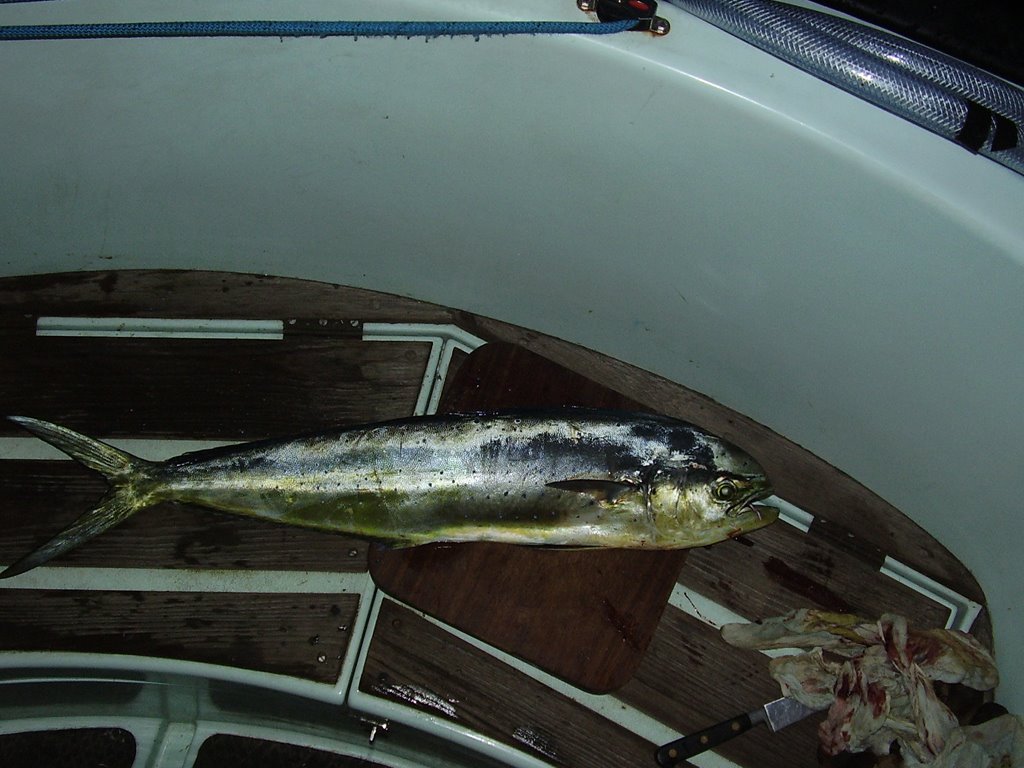
Another difference between the Atlantic and this crossing is the lack of physical milestones; for the Atlantic we had clearing the Canaries, reaching the Cape Verde Islands, arriving at the trade wind belt, Christmas etc. Here we need to create our own, so today's milestone: we have less than 2000 miles to go; we're a third of the way there already.
---
Position @ 19:30 UTC: S05°39' W105°04'
Daily distance run: 159
Distance to go: 1957
Cumulative distance: 902
Engine hours:0
Wind: ESE 10-15knots
Weather: moderate sea, clear skies, 1012 millibars
Monday, June 05, 2006
Best Daily Run
Another great sail! Beautiful day with consistent wind and a moderate sea although the wave height has increased significantly. Fortunately the interval between waves is sufficient to keep us relatively comfortable. Having some variety to the seascape in the form of peaks and troughs is much more interesting to watch than a flat calm surface. It's mesmerising the way they merge and peak and the effect they have on the hull (or perhaps I should just get out more!) No wildlife to speak of except flocks of fleeing flying fish and some hardy storm petrels, 800 miles from land, but we are ever hopeful of spotting less plentiful sea creatures.
Currently we are on a course which will take us south of the Marquesas, but we are hoping that the wind will veer to the south enabling us to sail on a broad-reach on the rhumb line direct to our waypoint just south of Fatu Hiva.
Position @ 18:58 UTC: S04°41' W103°33'
Daily distance run: 156
Distance to go: 2116
Cumulative distance: 749
Engine hours:0
Wind: SE 10-15knots
Weather: moderate sea, clear skies, 1011 millibars
Sunday, June 04, 2006
Pacific birthday
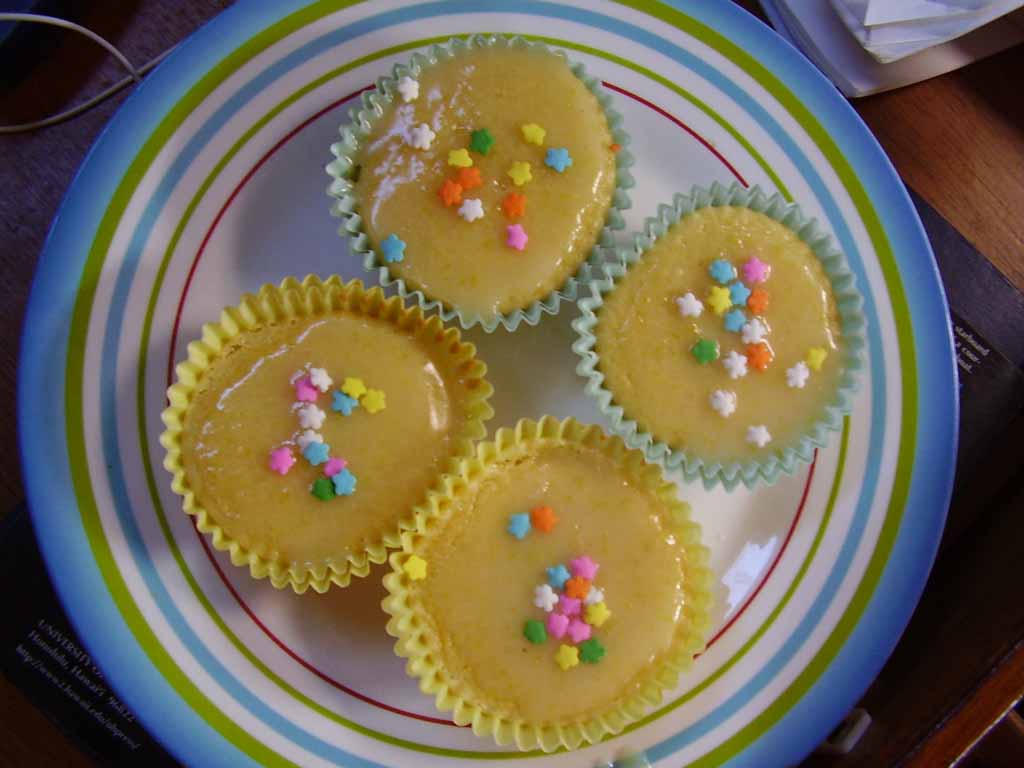
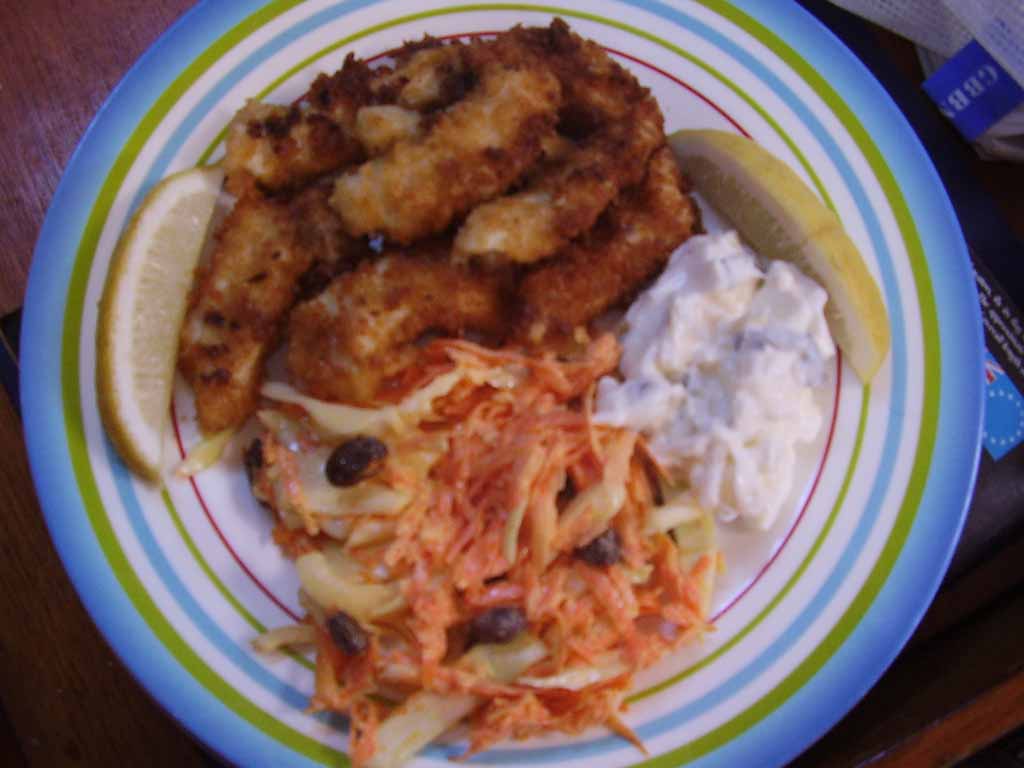
Life doesn't get much better than this - delicious freshly caught fish, cake, birthday poetry, and great sailing on a smooth sea.
A poem from Kika's first mate read out on our morning net by Carolyn on Revision II:
A long, long time ago
Nickster's life was very different
He had a flat, a scooter and a job in management
He wore a tie, washed his clothes, showered every day
Visited All Bar One, Sainsbury's and the cinema on Sunday
Sometimes he'd talk with passion about circumnavigation
But he didn't really mean it, was just his imagination.
Then one happy day, he saw an amazing chance
'forget summer sailing in the Solent and in France!
Let's do it', he said excitedly 'Let's go for it now
Before it's too late and you realise just how...
Seasick you will get, how sunburnt and smelly,
Break out of your shackles Ellen, turn off that telly!'
So we did, and here we are, and doesn't it feel great
He's worked so hard to do it and I'm lucky I'm first mate.
He's handy with a spanner, clever with epoxy,
Understands the weather and when it comes to charts, he...
Uses good seamanship, plotting waypoints, taking bearings,
And as for his computer skills, he's not averse to sharing.
Kika's been a challenge, and Nick likes nothing more
Than sitting in her cockpit remembering her before...
He made the many changes to help us on our way
Generator, wind vane and a fridge that works ok.
In the galley he tries hard, not just opening a tin
and I don't mind being reminded lest I forget who's the Captain.
Nickster works hard and he deserves to have fun
He's made many friends in these latitudes of sun
And I know you'll all wish him safe sailing all the way
Till we get the the Marquesas where we can all celebrate his birthday.
----
From Will and Alyssa on Ragtime:
There was a young man named Nick
fixing things was his favorite trick,
On Kika his boat
he learnt how to float,
And fixed all that broke
with a big wad of notes.
Ellen, his first mate
he decided to date,
And impressed her no end
with his cruising friends,
So with Pedro in tow
they decided to go,
And sailed away
in the month of May,
With a dream of wind on the beam.
Their life in the sun
is so much fun,
Spending loads of notes
and getting broke,
But drinking beer and wine
makes everything fine,
They wouldn't go home
even if they were given the throne.
Nick's birthday's at sea
and if it were me,
I'd get drunk as a skunk
and pass out in my bunk,
We hope you get cake
and gifts poor Ellen has to make,
All aboard Ragtime
think you'll have a fine time,
So with your first mate
go celebrate!
Finally from Carolyn and Andrew on Revision II
Hi ya you two - finally got around to typing this up for you - not sure
it is really worthy of your blog but here you go!
We first met Nicholas Ager,
many moons ago in Graciosa,
with Ellen, Mark and Natalia in tow,
off to the bars they did go
But twas improvements to the good ship Kika
that joined the Nickster and the Neighbour!!
Nigel Calder was regaled,
while the new solar panal was unveiled.
Friendship followed with R2's crew and Cap't,
through regular emails and occasional chat,
we monitored the blog with eyes of green,
as Kika ventured off to places unseen.
Panama brought us back together,
and by now Nick is a real pro skipper.
Always one to lend and share,
even when a treasured tape meets disrepair! (sorry)
Often impressed by a trumpet performance,
although the cycling of clothes made us glance.
First principle cooking always the key,
to the jolly, smiley computer geek that's he!
So on your Birthday Nicholas,
lets raise a cheer and have a glass.
We feel honored to have you as our friend,
well beyond this journey's end.
x x
-------
Position @ 18:30 UTC: S04° 04' W101° 01'
Daily distance run: 144
Distance to go: 2272
Cumulative distance: 610
Engine hours:0
Wind: SE/S 10-15knots
Weather: moderate sea, clear skies, 1012 millibars
A poem from Kika's first mate read out on our morning net by Carolyn on Revision II:
A long, long time ago
Nickster's life was very different
He had a flat, a scooter and a job in management
He wore a tie, washed his clothes, showered every day
Visited All Bar One, Sainsbury's and the cinema on Sunday
Sometimes he'd talk with passion about circumnavigation
But he didn't really mean it, was just his imagination.
Then one happy day, he saw an amazing chance
'forget summer sailing in the Solent and in France!
Let's do it', he said excitedly 'Let's go for it now
Before it's too late and you realise just how...
Seasick you will get, how sunburnt and smelly,
Break out of your shackles Ellen, turn off that telly!'
So we did, and here we are, and doesn't it feel great
He's worked so hard to do it and I'm lucky I'm first mate.
He's handy with a spanner, clever with epoxy,
Understands the weather and when it comes to charts, he...
Uses good seamanship, plotting waypoints, taking bearings,
And as for his computer skills, he's not averse to sharing.
Kika's been a challenge, and Nick likes nothing more
Than sitting in her cockpit remembering her before...
He made the many changes to help us on our way
Generator, wind vane and a fridge that works ok.
In the galley he tries hard, not just opening a tin
and I don't mind being reminded lest I forget who's the Captain.
Nickster works hard and he deserves to have fun
He's made many friends in these latitudes of sun
And I know you'll all wish him safe sailing all the way
Till we get the the Marquesas where we can all celebrate his birthday.
----
From Will and Alyssa on Ragtime:
There was a young man named Nick
fixing things was his favorite trick,
On Kika his boat
he learnt how to float,
And fixed all that broke
with a big wad of notes.
Ellen, his first mate
he decided to date,
And impressed her no end
with his cruising friends,
So with Pedro in tow
they decided to go,
And sailed away
in the month of May,
With a dream of wind on the beam.
Their life in the sun
is so much fun,
Spending loads of notes
and getting broke,
But drinking beer and wine
makes everything fine,
They wouldn't go home
even if they were given the throne.
Nick's birthday's at sea
and if it were me,
I'd get drunk as a skunk
and pass out in my bunk,
We hope you get cake
and gifts poor Ellen has to make,
All aboard Ragtime
think you'll have a fine time,
So with your first mate
go celebrate!
Finally from Carolyn and Andrew on Revision II
Hi ya you two - finally got around to typing this up for you - not sure
it is really worthy of your blog but here you go!
We first met Nicholas Ager,
many moons ago in Graciosa,
with Ellen, Mark and Natalia in tow,
off to the bars they did go
But twas improvements to the good ship Kika
that joined the Nickster and the Neighbour!!
Nigel Calder was regaled,
while the new solar panal was unveiled.
Friendship followed with R2's crew and Cap't,
through regular emails and occasional chat,
we monitored the blog with eyes of green,
as Kika ventured off to places unseen.
Panama brought us back together,
and by now Nick is a real pro skipper.
Always one to lend and share,
even when a treasured tape meets disrepair! (sorry)
Often impressed by a trumpet performance,
although the cycling of clothes made us glance.
First principle cooking always the key,
to the jolly, smiley computer geek that's he!
So on your Birthday Nicholas,
lets raise a cheer and have a glass.
We feel honored to have you as our friend,
well beyond this journey's end.
x x
-------
Position @ 18:30 UTC: S04° 04' W101° 01'
Daily distance run: 144
Distance to go: 2272
Cumulative distance: 610
Engine hours:0
Wind: SE/S 10-15knots
Weather: moderate sea, clear skies, 1012 millibars
Saturday, June 03, 2006
Cetacean Sightings
We've made really good progress over the last 24 hours and Kika is still steaming along at 6.5 knots. We are 'goose-winging' west now and the wind is directly behind us resulting in a motion not unlike the Atlantic crossing - rolling back and forth like a pendulum. It's quite wearing and even Kika protests when it's like this with her many squeaks and groans. Yesterday was a great day though: cloudless sky, moderate sea and a consistent wind. We found a tiny squid on the deck in the morning and a flying fish. We put the fishing line out at about 10.30 and caught another beautiful dorado (mahi-mahi) within the hour. They are extraordinary looking fish, and such a vibrant green it has to be seen to be believed. We had a delicious lunch of a fillet each with rice and homemade coleslaw. We are really eating well on this passage!
At about 3pm yesterday, Nick was having a snooze and I was pottering in the galley fixing a snack. I started up the companionway and caught sight of something big, black and shiny submerging just beyond Kika's stern. It was no more than 10 feet behind us and I was a little ruffled. You hear very mixed stories about whales and their interaction with boats and this one was interacting. I called Nick (we have a rule that if I need him urgently when he's asleep, I just say what I need him for without beating about the bush, so I just said 'whale!) and he climbed out to have a look. We counted 8 pilot whales though there were probably more, and some of them were mothers and calves. They were swimming all around the boat, almost like they were escorting us. A particularly large one swam just under the surface almost touching the starboard side. It was 15 feet at least.
We had a great time just watching their huge, graceful bodies and we were very lucky to see them up so close. They surfaced regularly but even below the surface we could see them really clearly due to the excellent light conditions. They stayed with us for about 20 minutes and strangely, their pod was joined by some enormous, acrobatic dolphins. We didn't know where to look. Each dolphin was over 2 metres long and they were racing through the water at lightening speed, crossing Kika's bow with inches to spare. It was a wonderful sight and thankfully Nick managed to catch it on video just incase we thought it was all a dream.
Gradually we watched the whales pull away from Kika one by one. The dolphins too did their disappearing act. It's amazing how desolate you feel after a short visit from them. You can never have enough dolphin in your life. It made us wonder what the they and the whales think of us. Do they see the boat as a living thing, perhaps a potential threat, or are they just nosey? It has been speculated that dolphins just enjoy the slipstream a large vessel makes. Whatever their reasons for spending time with us, we felt very privileged to have witnessed them.
Position @ 18:50 UTC: S02°36' W94°07.0'
Daily distance run: 150
Distance to go: 2416
Cumulative distance: 476
Engine hours:0
Wind: SE/S 10-15knots
Weather: moderate sea, clear skies, 1011 millibars
At about 3pm yesterday, Nick was having a snooze and I was pottering in the galley fixing a snack. I started up the companionway and caught sight of something big, black and shiny submerging just beyond Kika's stern. It was no more than 10 feet behind us and I was a little ruffled. You hear very mixed stories about whales and their interaction with boats and this one was interacting. I called Nick (we have a rule that if I need him urgently when he's asleep, I just say what I need him for without beating about the bush, so I just said 'whale!) and he climbed out to have a look. We counted 8 pilot whales though there were probably more, and some of them were mothers and calves. They were swimming all around the boat, almost like they were escorting us. A particularly large one swam just under the surface almost touching the starboard side. It was 15 feet at least.
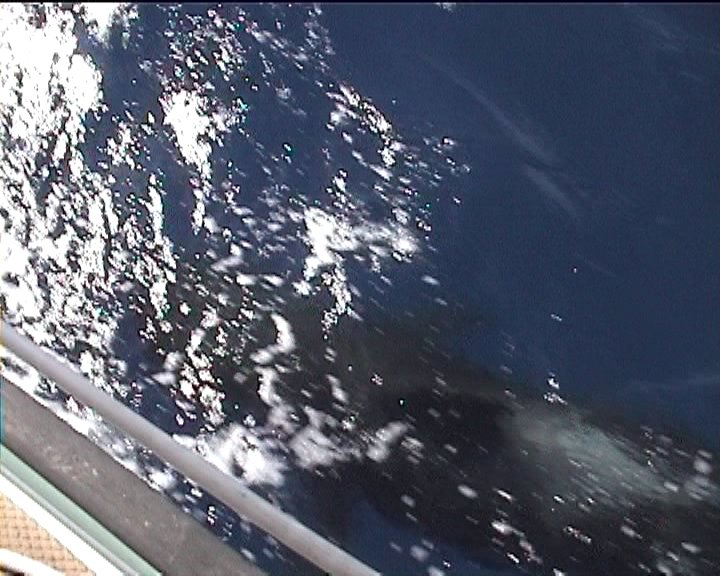
We had a great time just watching their huge, graceful bodies and we were very lucky to see them up so close. They surfaced regularly but even below the surface we could see them really clearly due to the excellent light conditions. They stayed with us for about 20 minutes and strangely, their pod was joined by some enormous, acrobatic dolphins. We didn't know where to look. Each dolphin was over 2 metres long and they were racing through the water at lightening speed, crossing Kika's bow with inches to spare. It was a wonderful sight and thankfully Nick managed to catch it on video just incase we thought it was all a dream.

Gradually we watched the whales pull away from Kika one by one. The dolphins too did their disappearing act. It's amazing how desolate you feel after a short visit from them. You can never have enough dolphin in your life. It made us wonder what the they and the whales think of us. Do they see the boat as a living thing, perhaps a potential threat, or are they just nosey? It has been speculated that dolphins just enjoy the slipstream a large vessel makes. Whatever their reasons for spending time with us, we felt very privileged to have witnessed them.
Position @ 18:50 UTC: S02°36' W94°07.0'
Daily distance run: 150
Distance to go: 2416
Cumulative distance: 476
Engine hours:0
Wind: SE/S 10-15knots
Weather: moderate sea, clear skies, 1011 millibars
Friday, June 02, 2006
Clear skies, great sailing
A great day's sailing - we've been making 6-7 knots on a broad reach and in more comfort than the roly Atlantic sailing we experienced. The wind is becoming more consistent, although it hasn't completely settled down yet - a couple of times today I reefed the main, only for the wind to die away 15 minutes later. It's frustrating when the wind vanishes and leaves the rig crashing around in the swell, but we've decided it's preferable to using the engine. When the wind dies we've taken to securing the wheel with the rudder dead ahead and let the trim of the sails determine the course, with the occasional nudge and sail adjustment from ourselves.
When we left Isabela there was little or no light at night - just our tiny mast-head light doing its best to penetrate the darkness. Tonight the sky is clear, with stars filling the skies and the moon becoming brighter by the day.
We've yet to see any other shipping and our radar detector has been silent - a complete contrast to the Atlantic when there were only a couple of days during the crossing when we were out of sight of other ship's radar. It all adds to the feeling that it's a vast ocean with nothing between us and the Marquesas.
No fishing today as we've had the tow generator out to replenish the charge in our batteries.
-------------------------------------------------------
Position @ 18:22 UTC: S03deg 15' W96deg 11'
Daily distance run: 130
Distance to go: 2566
Cumulative distance: 338
Engine hours:0
Wind: SE/S 10-15knots
Weather: moderate sea, clear skies, 1011 millibars
Wednesday, May 31, 2006
First Catch of the Trip
Over the past 24 hours we have had intermittent wind from the southeast, and our speed has ranged from 7 knots to 3. The sea is also very 'sloppy' meaning waves come from different directions and Kika rolls this way and that amongst them. So, not the most comfortable of starts but things should improve. Despite the conditions, I have not felt sick and was able to cook a delicious lunch this afternoon with the beautiful mahi-mahi we had just caught.
It has been pretty cloudy since we set off and we have just been through a rain shower which has cooled everything down further. It's much more pleasant not to be sailing in direct sunlight as the heat is, not surprisingly, quite savage.
As well as the mahi-mahi and many hardy little petrels which accompany us, we spotted 2 whales blowing off in the distance yesterday. We were too far away to identify them other than they were very big! No sign of any other vessels out here - we would feel pretty lonely if we didn't have the SSB, but as it is we have been able to chat to friends in the mornings and evenings - keeps us sane (I hope!)
Position @ 18:38 UTC: S02°36' W94°07.0'
Daily distance run: 122 nm
Distance to go: 2696 nm
Cumulative distance: 2696 nm
Engine hours: 0
Wind: SE/S 10-15 knots
Weather: moderate sea, overcast, 1010 millibars
Tuesday, May 30, 2006
2901 miles to the Marquesas
We've left the Galapagos islands bound for the Marquesas, 2901 nautical miles away. It's our longest passage to date and will probably be the longest passage of the whole trip. It's daunting to look at the empty ocean ahead of us on our chart, but we feel far more aware of what we're undertaking than when we left the Canaries for the Caribbean and the end prize of the South Pacific Islands are worth the occasional hardship.
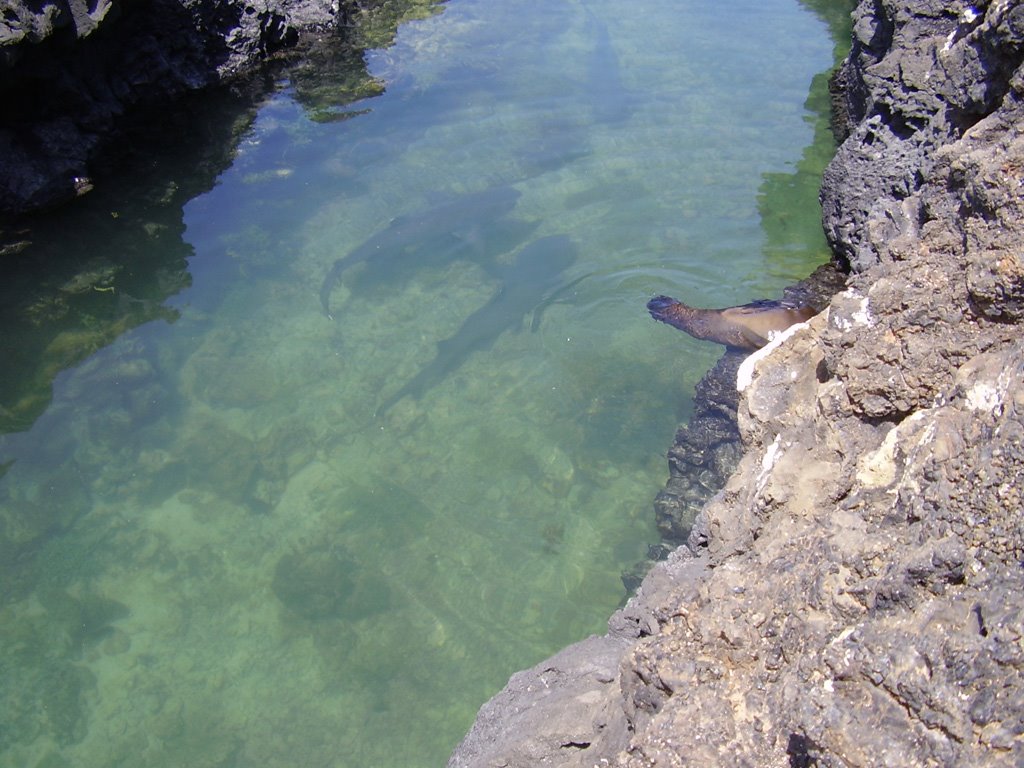
We left at 4.30pm Monday to the blast of fog horns from fellow sailors in the anchorage. Our five days there were mainly spent enjoying the unique wildlife, with a little boat preparation slotted in. As ever the wildlife was stunning; not far from the anchorage we saw white tip sharks circling in a pool and marooning a baby seal, until its mother arrived and dispersed the sharks by biting their tails.
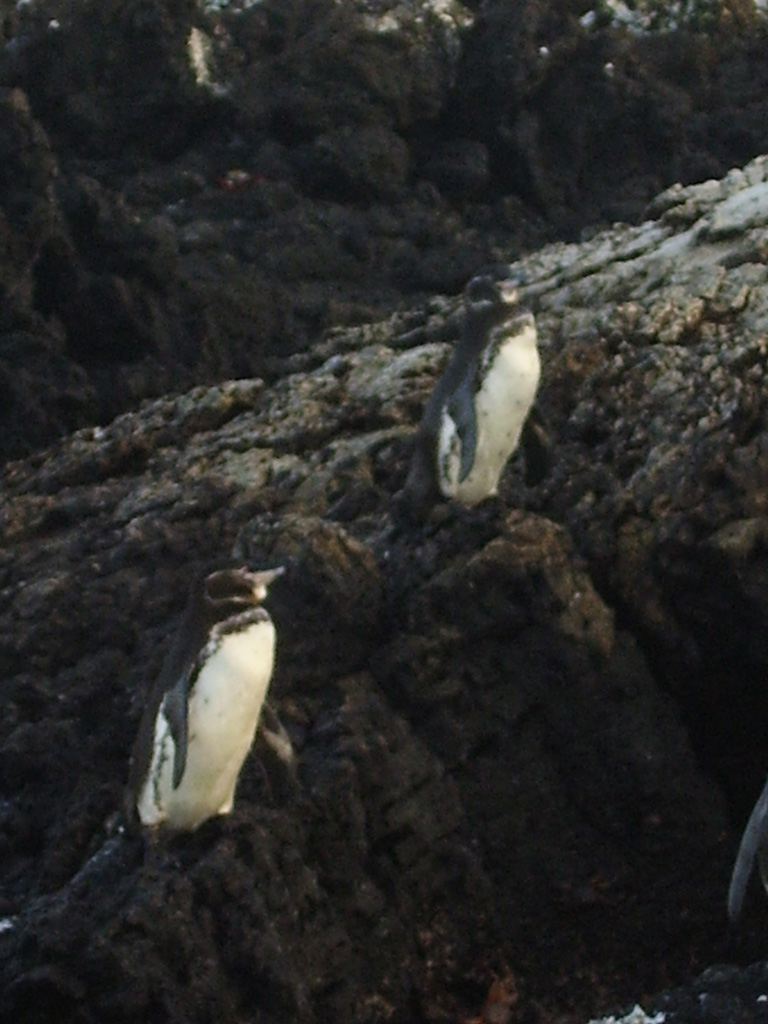
The volcanic rocks around the shore were home to 1000s of marine iguanas, blue footed boobies and Galapagos penguins - amazing considering we were within 60 miles of the equator. We were also treated by the occasionally turtle swimming through the anchorage. An hour after leaving we saw two large dorsal fins looming out of the waves close the boat, which we decided must be a couple of large sharks. It feels as though we've been granted a privileged peek into the wildlife of the Galapagos, and although our time is up, we'd happily return again.
It seems that the start of a passage on Kika wouldn't be complete without a perplexing wind-vane steering problem. When we left Isabela we had 10knots of wind from the SE and initially headed SSW to clear the island. George the wind-vane had been expertly steering on fine-reaches such as this on our way to the Galapagos (once we'd corrected my reassembly error) so we couldn't understand why we were yawing from dead into the wind to broad-reach (120 degrees), under his control. For once I hadn't tampered with the steering, so we struggled to understand what had changed. The prospect of 2901 miles without working wind-vane steering wasn't appealing. My first plan of a liberal application of oil made little difference. Then pondering the problem it appeared that the wind wasn't strong enough to move the vane back vertical once it had been blown over. However 10 knots of wind should easily be sufficient so I reasoned that the problem must lie with the vane. I'd taken it off and tied it to the cockpit coaming; perhaps it had soaked up water during a washing frenzy, making the vane too heavy.
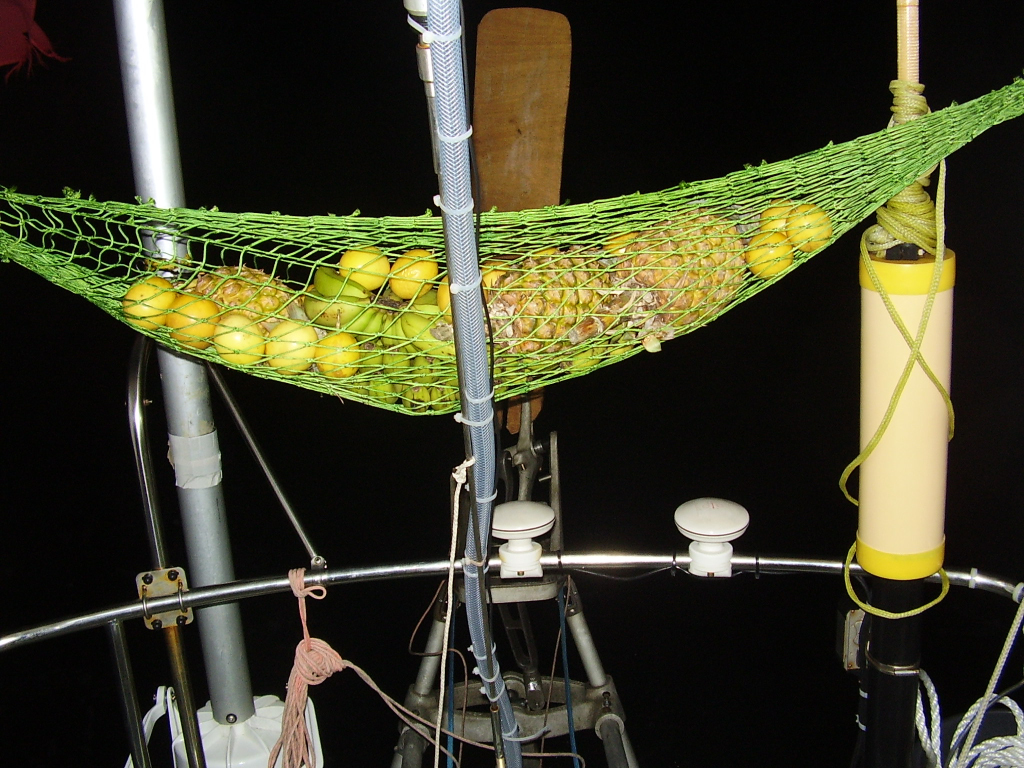
Pleased with my diagnosis I set about locating and then cutting our spare plywood into a rough vane shape in the now dark cockpit, convinced that this would provide the answer. Half an hour later it was clear that the new vane suffered the same problem as the old one. What had changed? I just couldn't work it out. Not until I was bashed on the head, while leaning over the stern to ponder the vane's erratic course, did I have my Newtonian flash of inspiration. The fruit net was so full of produce from the Galapagos that it was disrupting the flow of air to the vane. Moving the net higher up and clear of the air-flow solved the problem. Not exactly a gravity inventing knock to the head, but a eureka moment none-the-less.
-------------------------
Position @ 18:07 UTC: S02°05.0' W92°08.0'
Daily distance run: 83
Distance to go: 2818
Cumulative distance: 97
Engine hours:0.5
Wind: SE/S 10knots
Weather: lumpy sea, overcast, 1010 millibars
We left at 4.30pm Monday to the blast of fog horns from fellow sailors in the anchorage. Our five days there were mainly spent enjoying the unique wildlife, with a little boat preparation slotted in. As ever the wildlife was stunning; not far from the anchorage we saw white tip sharks circling in a pool and marooning a baby seal, until its mother arrived and dispersed the sharks by biting their tails.
The volcanic rocks around the shore were home to 1000s of marine iguanas, blue footed boobies and Galapagos penguins - amazing considering we were within 60 miles of the equator. We were also treated by the occasionally turtle swimming through the anchorage. An hour after leaving we saw two large dorsal fins looming out of the waves close the boat, which we decided must be a couple of large sharks. It feels as though we've been granted a privileged peek into the wildlife of the Galapagos, and although our time is up, we'd happily return again.
It seems that the start of a passage on Kika wouldn't be complete without a perplexing wind-vane steering problem. When we left Isabela we had 10knots of wind from the SE and initially headed SSW to clear the island. George the wind-vane had been expertly steering on fine-reaches such as this on our way to the Galapagos (once we'd corrected my reassembly error) so we couldn't understand why we were yawing from dead into the wind to broad-reach (120 degrees), under his control. For once I hadn't tampered with the steering, so we struggled to understand what had changed. The prospect of 2901 miles without working wind-vane steering wasn't appealing. My first plan of a liberal application of oil made little difference. Then pondering the problem it appeared that the wind wasn't strong enough to move the vane back vertical once it had been blown over. However 10 knots of wind should easily be sufficient so I reasoned that the problem must lie with the vane. I'd taken it off and tied it to the cockpit coaming; perhaps it had soaked up water during a washing frenzy, making the vane too heavy.
Pleased with my diagnosis I set about locating and then cutting our spare plywood into a rough vane shape in the now dark cockpit, convinced that this would provide the answer. Half an hour later it was clear that the new vane suffered the same problem as the old one. What had changed? I just couldn't work it out. Not until I was bashed on the head, while leaning over the stern to ponder the vane's erratic course, did I have my Newtonian flash of inspiration. The fruit net was so full of produce from the Galapagos that it was disrupting the flow of air to the vane. Moving the net higher up and clear of the air-flow solved the problem. Not exactly a gravity inventing knock to the head, but a eureka moment none-the-less.
-------------------------
Position @ 18:07 UTC: S02°05.0' W92°08.0'
Daily distance run: 83
Distance to go: 2818
Cumulative distance: 97
Engine hours:0.5
Wind: SE/S 10knots
Weather: lumpy sea, overcast, 1010 millibars
Enda Brenda?
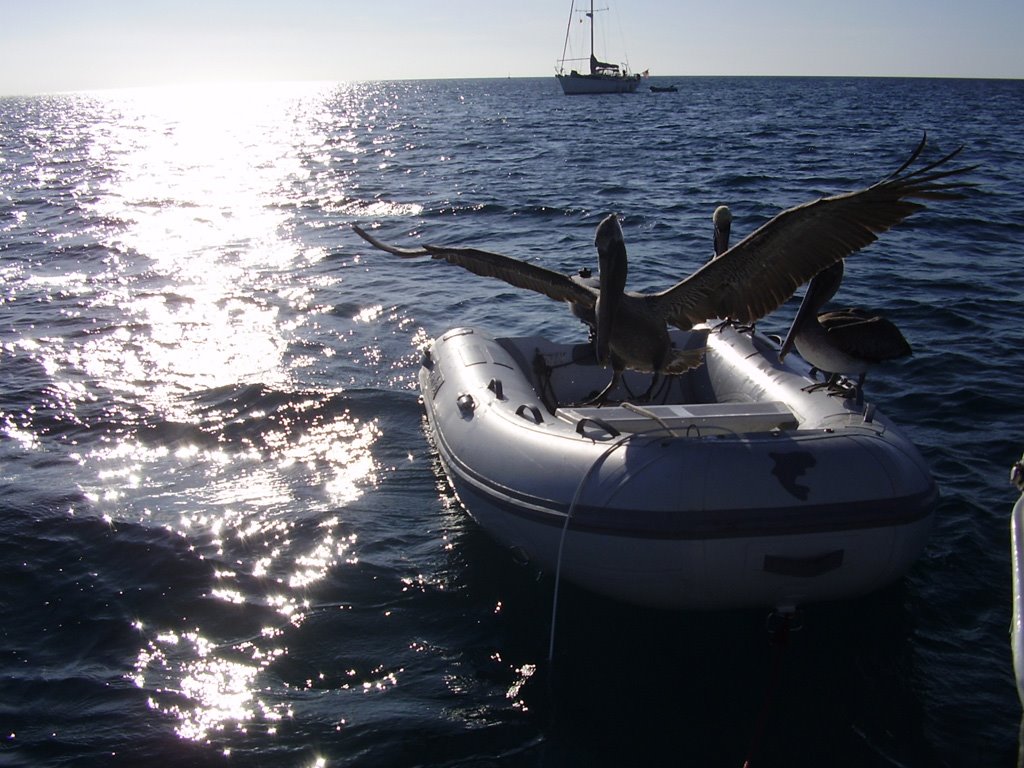
Some of you more observant viewers of the blog may have noticed a slight change in our equipment i.e. that of our new, smart Carib dinghy as featured in recent photographs. Many of our cruising friends have been admiring our new acquisition and even enjoying dry trips within her beguiling, prodigious tubes, but, like you, have also voiced concern as to the whereabouts of our old grey Avon, Brenda. Well, it's no use pretending, Brenda has certainly been superseded but we felt that was no reason to neglect her so she has been cleaned and stowed in her old home in the forepeak, and is ready for action should anybody ever need her. She has many more years of service left but sadly her design is redundant and we were powerless to resist the modern, curvy lines of the new generation dinghies with their promise of a dry, comfortable trip ashore and even a little fun if we get a more powerful outboard (Nigel's next on the list for replacement!). Our new dinghy is called Jordan and she is pretty magnificent, we're sure you will agree. Those pelicans certainly did!
Friday, May 26, 2006
Cycling over Oranges
When I'd imagined the Galapagos I thought we'd discover a few earnest scientists in makeshift tents and maybe we'd chance upon David Attenborough and a film crew.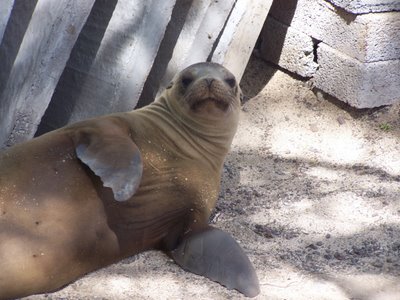 So I was ill-prepared for a settlement complete with a one-way system, water taxis and internet cafes. That said we've enjoyed its comforts, particularly the cafes and it's not exactly overrun with tourists - there appear to be more taxis than visitors. As we set sail for Isabela the lights of Wreck Bay quickly faded behind us and it became apparent that the vast majority of the Island is uninhabited and left to the tortoises, and other endemic species.
We had a great time in San Cristobal. On our penultimate day we cycled from the highlands to the anchorage, refreshing ourselves on the wild fruit as we descended. It's a first for me to pick and eat oranges directly from a tree.
Although our search for mangoes was unsuccessful we feasted on guava, crab apples and blackberries. They are all introduced species, but the blackberries are particularly virulent with our guide describing them as a "plaga" - a plague.
We've also ventured beneath the water, starting with a refresher dive in the harbour. Sea-lions accompanied us throughout and appeared fascinated by us; darting around us and mimicking us as we practised buoyancy control on the bottom. Sea lions here are as numerous as sheep in the Lake District, but their antics are no-less intriguing for their numbers.
The practice dive was followed by a boat trip to Kicker Rock in company with our fellow cruisers. We had a couple of fantastic dives seeing Galapagos sharks, turtles, the odd ray and a multitude of other fish.It's also been great fun watching life in town. When the supply ships arrive they anchor in the bay then everything is ferried ashore in small skiffs. The pier quickly fills up with crates of fruit and veg, building supplies, fridges etc.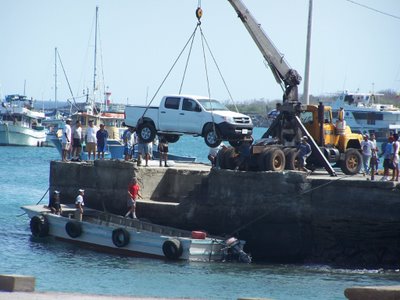
During our stay in San Cristobal a familiar vessel arrived in the anchorage almost every day providing the existing boats with an excuse for a celebration.
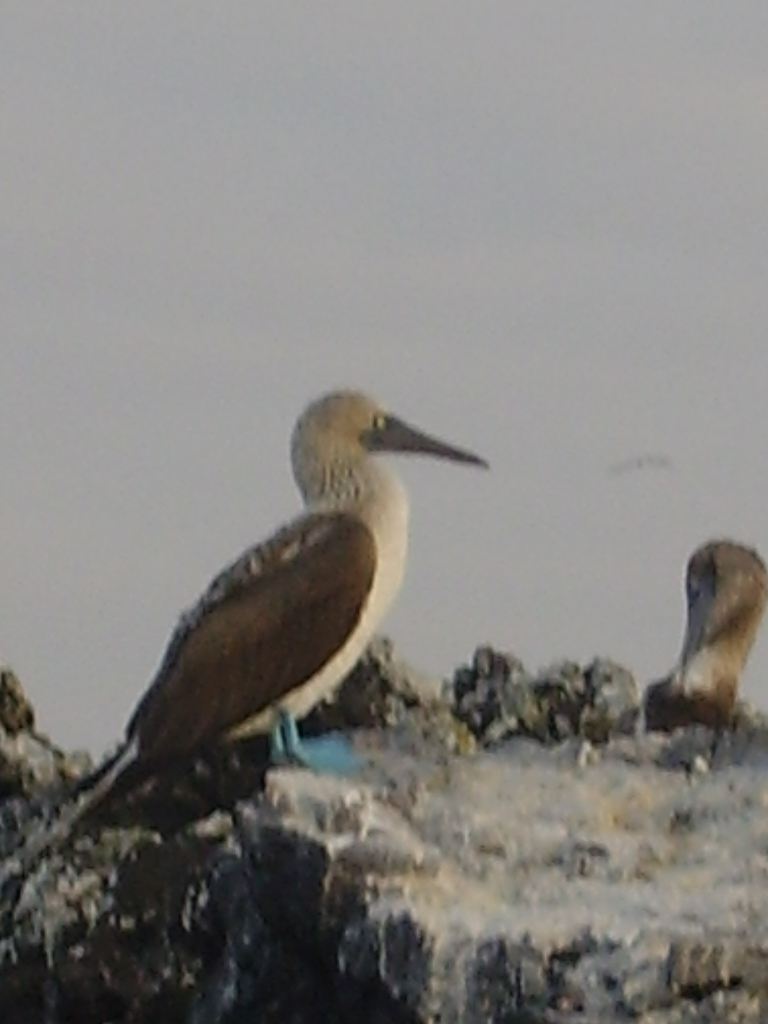
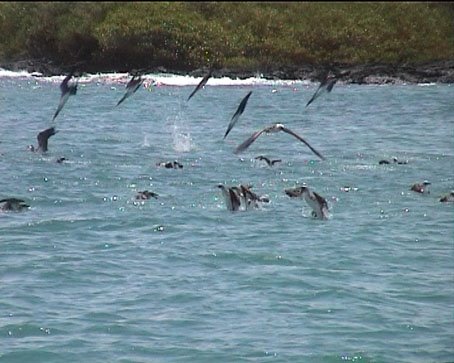
One of the most intriguing Galapagos species we've encountered is the blue-footed booby. Their feet are bright blue like they've just stepped in a puddle of paint. When we arrived in the anchorage in Isabela, we were greeted by a large flock, on a feeding frenzy, dive bombing the water around us.
Yesterday we arranged to head up to the volcanoes in Isabela. The trip involved an hour pick-up ride across dust tracks then an hour and a half on horseback. In the event there was some confusion between our guide and the national park officials and we ended up on a truncated tour back to the horse-owner's farm. After the first ten minutes or so of equestrian acclimatisation I started to enjoy the ride and for once my steed appeared to respond to my will. Fortunately I'm not too stiff this morning, although Ellen appears to be a little bruised, and there was I worried that my childhood devoid of junior-gymkhanas would put me at a disadvantage!
Isabela anchorage: S00°57.90' W90°57.73'
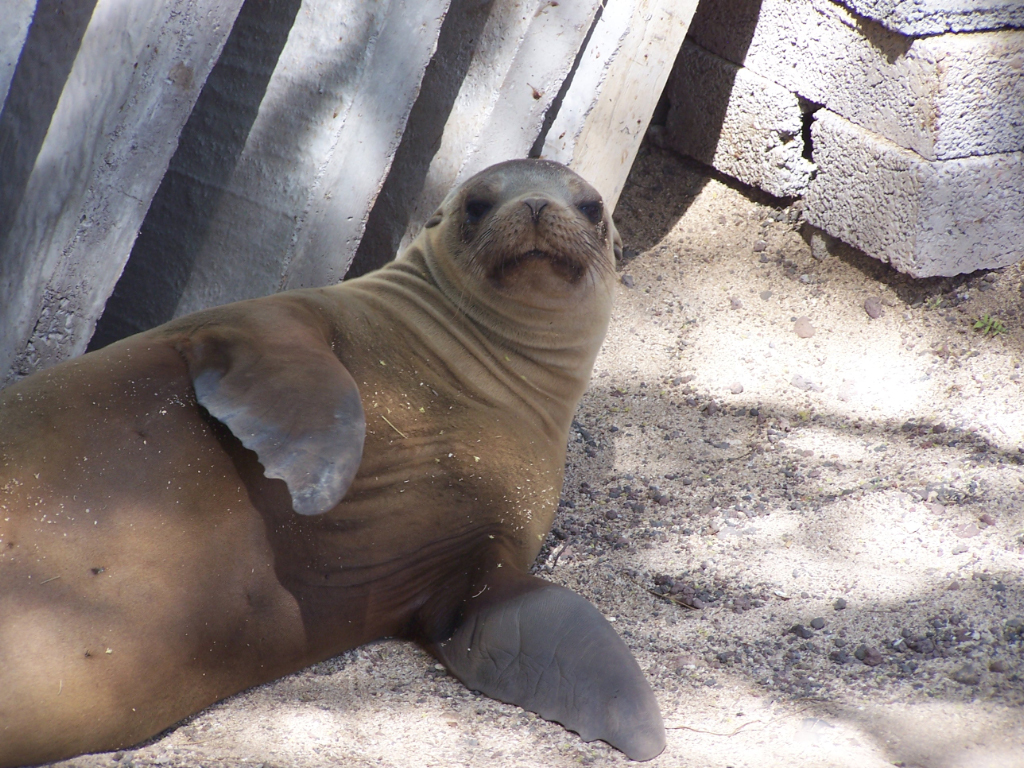
We had a great time in San Cristobal. On our penultimate day we cycled from the highlands to the anchorage, refreshing ourselves on the wild fruit as we descended. It's a first for me to pick and eat oranges directly from a tree.
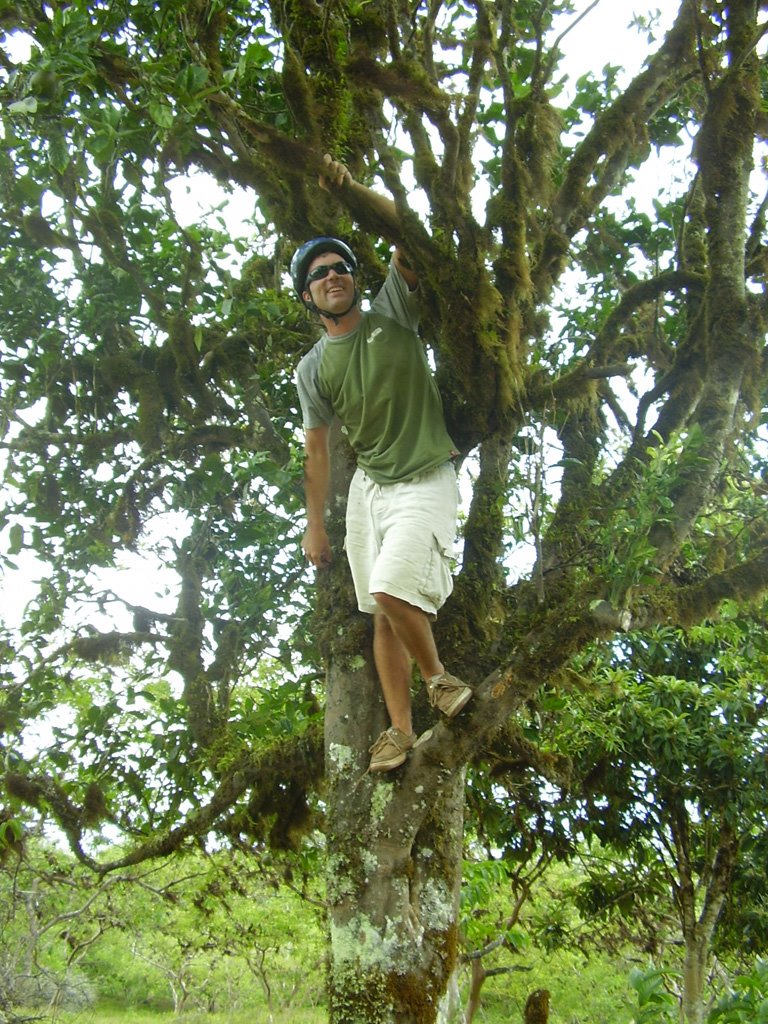
Although our search for mangoes was unsuccessful we feasted on guava, crab apples and blackberries. They are all introduced species, but the blackberries are particularly virulent with our guide describing them as a "plaga" - a plague.
We've also ventured beneath the water, starting with a refresher dive in the harbour. Sea-lions accompanied us throughout and appeared fascinated by us; darting around us and mimicking us as we practised buoyancy control on the bottom. Sea lions here are as numerous as sheep in the Lake District, but their antics are no-less intriguing for their numbers.

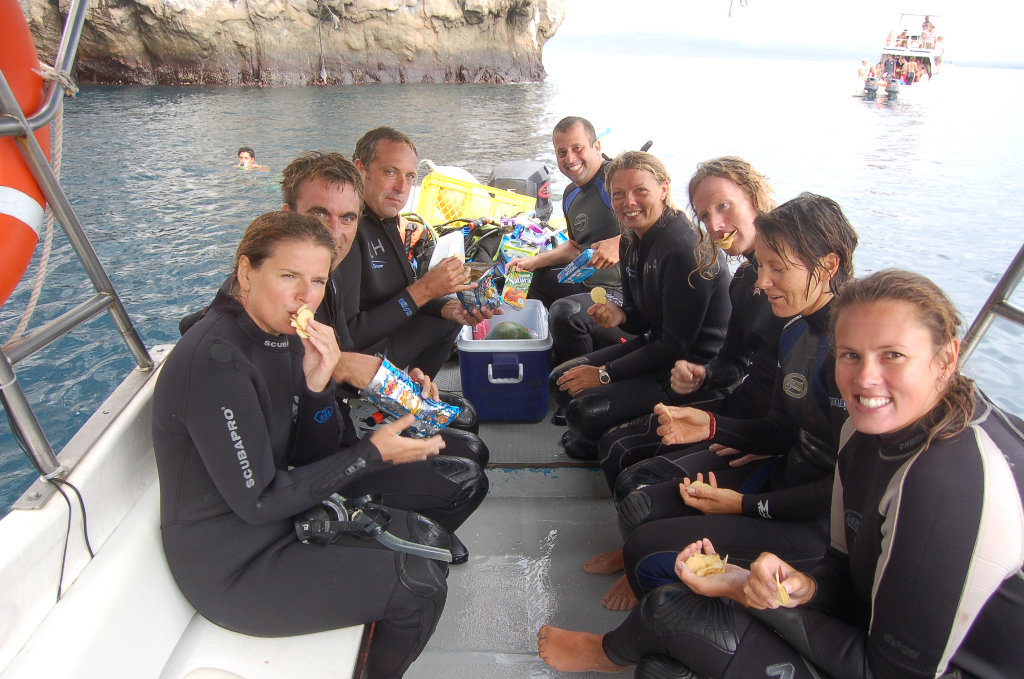
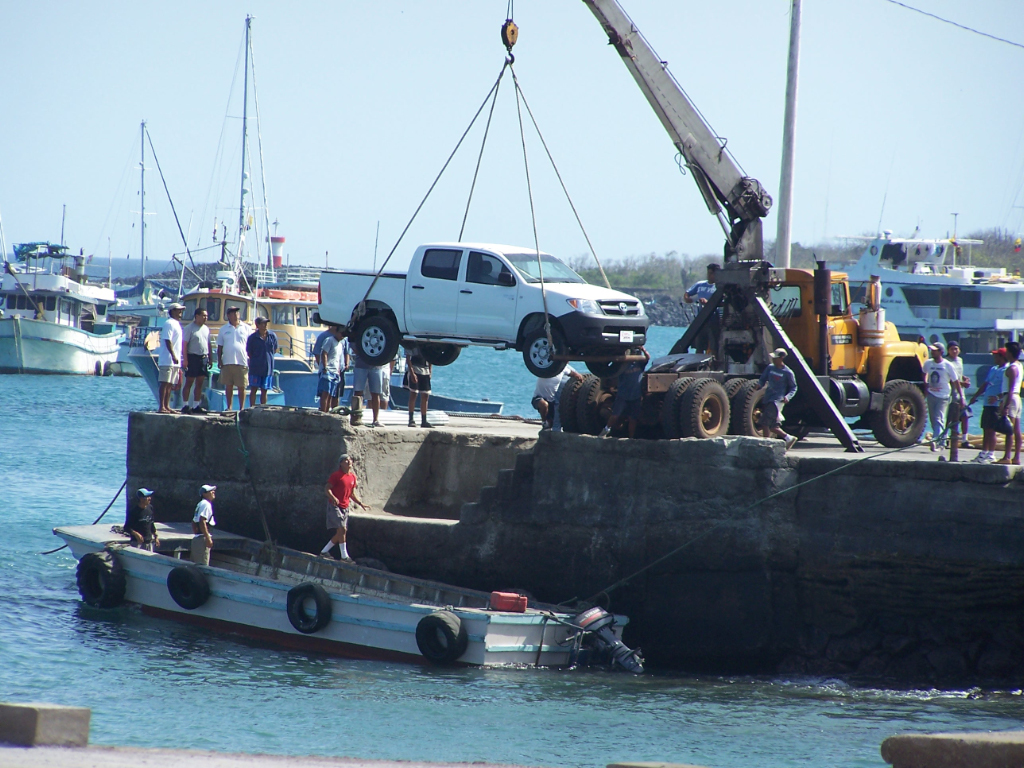
The practice dive was followed by a boat trip to Kicker Rock in company with our fellow cruisers. We had a couple of fantastic dives seeing Galapagos sharks, turtles, the odd ray and a multitude of other fish.It's also been great fun watching life in town. When the supply ships arrive they anchor in the bay then everything is ferried ashore in small skiffs. The pier quickly fills up with crates of fruit and veg, building supplies, fridges etc.
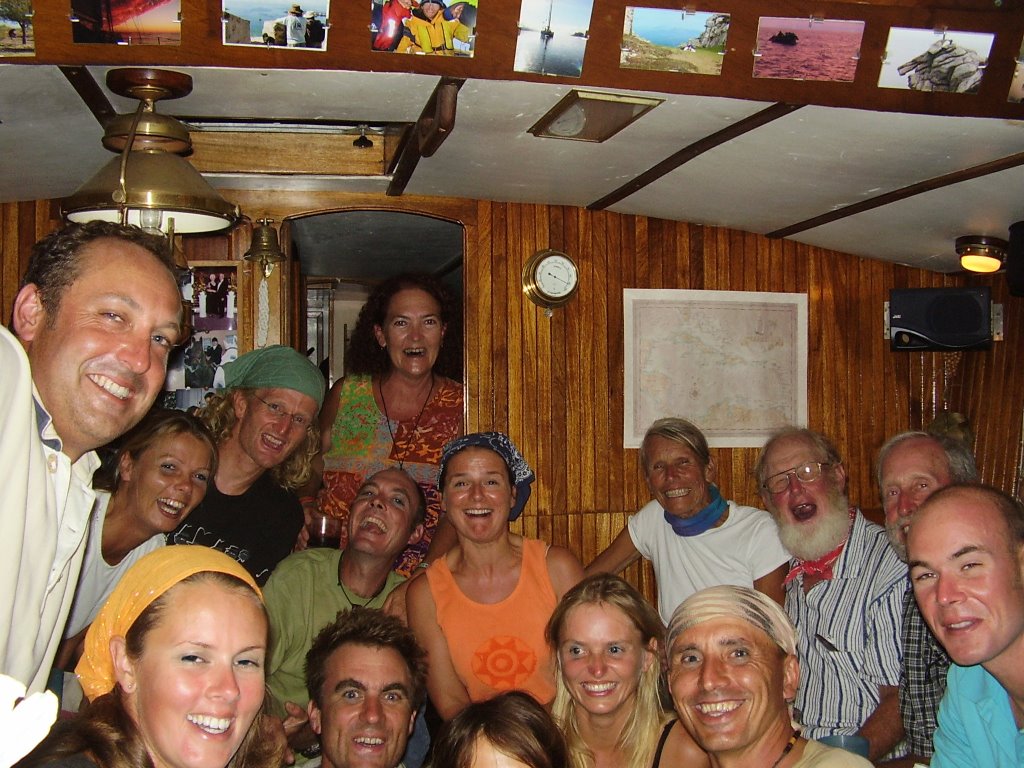
During our stay in San Cristobal a familiar vessel arrived in the anchorage almost every day providing the existing boats with an excuse for a celebration.
One of the most intriguing Galapagos species we've encountered is the blue-footed booby. Their feet are bright blue like they've just stepped in a puddle of paint. When we arrived in the anchorage in Isabela, we were greeted by a large flock, on a feeding frenzy, dive bombing the water around us.

Yesterday we arranged to head up to the volcanoes in Isabela. The trip involved an hour pick-up ride across dust tracks then an hour and a half on horseback. In the event there was some confusion between our guide and the national park officials and we ended up on a truncated tour back to the horse-owner's farm. After the first ten minutes or so of equestrian acclimatisation I started to enjoy the ride and for once my steed appeared to respond to my will. Fortunately I'm not too stiff this morning, although Ellen appears to be a little bruised, and there was I worried that my childhood devoid of junior-gymkhanas would put me at a disadvantage!
Isabela anchorage: S00°57.90' W90°57.73'
Friday, May 19, 2006
Adventures in Galapagos
The approach to Wreck Bay along the north coast of San Cristobal was very picturesque and punctuated by sea lion, whale and turtle sightings, all serving to whet our appetites for the wonderful abundance and diversity of species to be found here. In the bay, the first species we encountered were enthusiastic and thirsty; Walter and Rita from Noa, and Will and Alyssa from Ragtime waved us in to the anchorage, and gave us time to anchor (just) before they dingied over to help us celebrate our arrival. It was fantastic to make landfall for all the obvious reasons, but also because during the passage, Ragtime had come into contact with a suspect fishing vessel which, judging from the crew's actions, had been intending to stop Ragtime and possibly board her. Alyssa had sent all vessels on our radio net an email describing the event and just warning us, and we had been keeping extra vigilant watches, but trying to identify small unlit boats at night is a challenge, and the stress of the potential hazard and consequences makes the watches rather onerous. Having arrived here, we were told that two other boats had similar experiences and had narrowly missed being boarded, but conversley, Andrew and Carolyn on Revision II had enjoyed a beer with a fishing vessel that approached them, so who knows? It's a strange world.
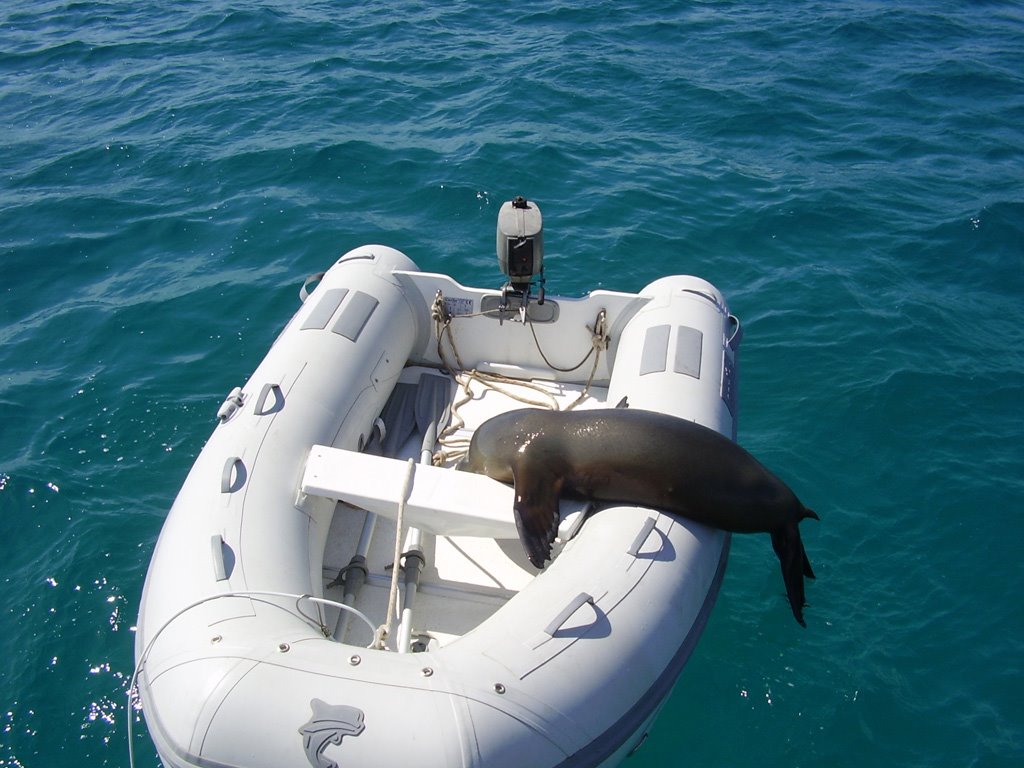
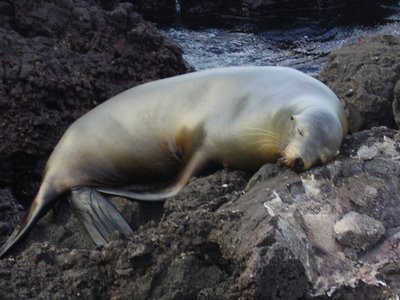
As the sun set and we all got mellow in Kika's cockpit, sea lions would intermittently hurl themselves over the sides of Ragtime's dinghy for a little sleep. They are delightful either sleeping on the sunkissed decks of dinghies and boats, or furiously darting through the water - there´s no halfway.
It is much cooler here than in Panama which is a great relief. The sea temperature is chilled by the Humboldt current, which is why the sea lions like it here so much, and this in turn cools the atmosphere. We woke on Sunday morning to what felt like a late summer's day in England with a distinct autumnal chill in the air - guaranteed to bring on a pang of homesickness!
We caught a water taxi into town and headed to check in with immigration and then the port captain. All went smoothly much to our relief, as various reports of the checking-in process suggested difficulties with communication and arbitrary charging methods. They must have liked us! We have spent this week doing the odd job aboard, but we have also managed to take time out and enjoy ourselves. The town is small but has all we need (I visited the launderette on Monday - service wash - excellent!) food is cheap and delicious and once again, the locals are interesting and friendly. The island has a varied landscape with undulating hills and a couple of volcanic peaks. It's mainly dry with hardy vegetation. We took a trip up the volcano on Monday and there the air was chilly and the environment reminded me of walking on moors at home.
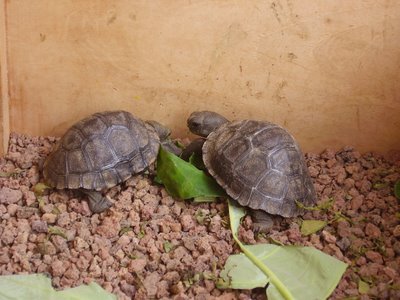
Since our arrival we have been lucky enough to see the giant tortoises (and some tea-cup sized infants in the tortoise nursery) which are being raised in a protected area not far from the bay.
Apparently they live to between 150 and 200 years. Sadly they were gravely endangered after whalers from the US and England took them (not difficult, they don´t move quickly) and stored them live in their ships´ holds for fresh meat on the way back home. They were extremely low maintenance livestock, surviving for up to a year without food or water.
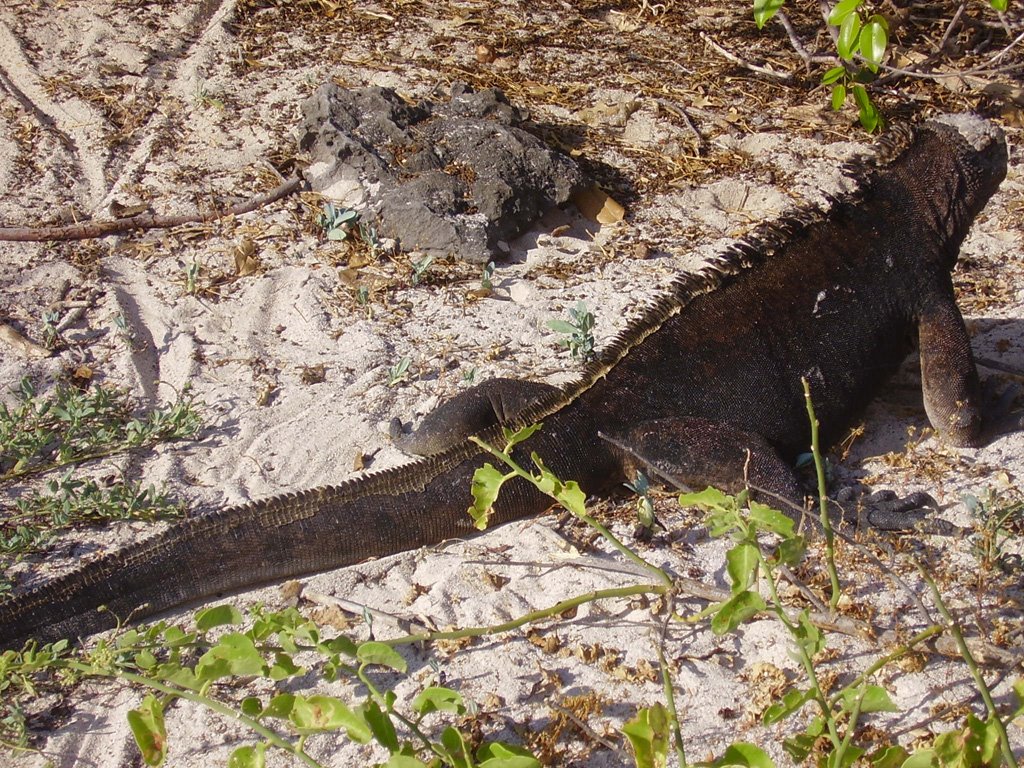
We have swum with some very playful and cheeky sea lions, been privy to a pelican catching its lunch, discovered huge black marine iguanas in the sand dunes and yesterday, we found ourselves unexpectedly swimming with a large turtle.
The amazing thing about this place is that despite its unrivalled position as top of the nature pops, there's no-one here! We haven't really had to share our experiences with anyone else and consequently there is a complete absence of taking your turn and straining to see round someone's backpack or oversize camera. There's just us and our backpacks and cameras!
Today the final boat in our net, Helene, is arriving (they had really bad luck with currents and winds on the passage from Panama which has prolonged their passage). In fact they are motoring into the bay as I write, so tonight there will be much jollity and celebration.
On Sunday, we are going SCUBA diving for the day and are looking forward to seeing more magical things. We have been promised a glimpse of hammerhead sharks, but I can live without that! I´m quite happy with some angel fish and a turtle or two thanks!
As the sun set and we all got mellow in Kika's cockpit, sea lions would intermittently hurl themselves over the sides of Ragtime's dinghy for a little sleep. They are delightful either sleeping on the sunkissed decks of dinghies and boats, or furiously darting through the water - there´s no halfway.

Sea lion at rest (for a change!)
It is much cooler here than in Panama which is a great relief. The sea temperature is chilled by the Humboldt current, which is why the sea lions like it here so much, and this in turn cools the atmosphere. We woke on Sunday morning to what felt like a late summer's day in England with a distinct autumnal chill in the air - guaranteed to bring on a pang of homesickness!
We caught a water taxi into town and headed to check in with immigration and then the port captain. All went smoothly much to our relief, as various reports of the checking-in process suggested difficulties with communication and arbitrary charging methods. They must have liked us! We have spent this week doing the odd job aboard, but we have also managed to take time out and enjoy ourselves. The town is small but has all we need (I visited the launderette on Monday - service wash - excellent!) food is cheap and delicious and once again, the locals are interesting and friendly. The island has a varied landscape with undulating hills and a couple of volcanic peaks. It's mainly dry with hardy vegetation. We took a trip up the volcano on Monday and there the air was chilly and the environment reminded me of walking on moors at home.
Since our arrival we have been lucky enough to see the giant tortoises (and some tea-cup sized infants in the tortoise nursery) which are being raised in a protected area not far from the bay.
Apparently they live to between 150 and 200 years. Sadly they were gravely endangered after whalers from the US and England took them (not difficult, they don´t move quickly) and stored them live in their ships´ holds for fresh meat on the way back home. They were extremely low maintenance livestock, surviving for up to a year without food or water.
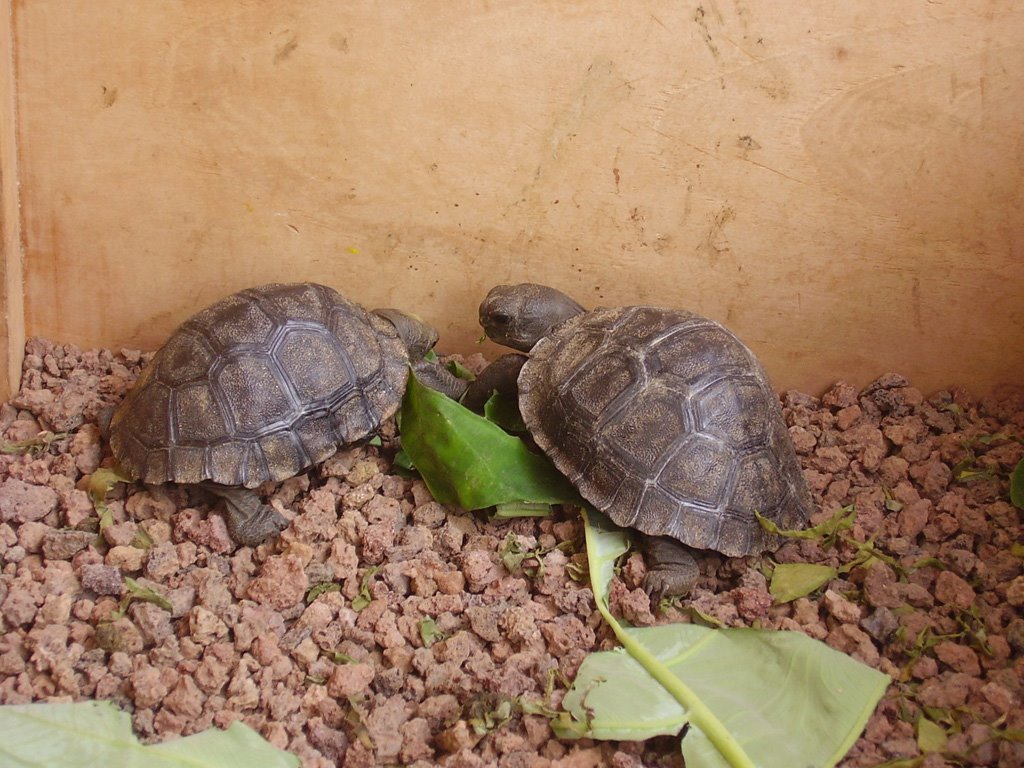
Pocket Size Pets (Do you think they´d miss one?)
We have swum with some very playful and cheeky sea lions, been privy to a pelican catching its lunch, discovered huge black marine iguanas in the sand dunes and yesterday, we found ourselves unexpectedly swimming with a large turtle.

The amazing thing about this place is that despite its unrivalled position as top of the nature pops, there's no-one here! We haven't really had to share our experiences with anyone else and consequently there is a complete absence of taking your turn and straining to see round someone's backpack or oversize camera. There's just us and our backpacks and cameras!
Today the final boat in our net, Helene, is arriving (they had really bad luck with currents and winds on the passage from Panama which has prolonged their passage). In fact they are motoring into the bay as I write, so tonight there will be much jollity and celebration.
On Sunday, we are going SCUBA diving for the day and are looking forward to seeing more magical things. We have been promised a glimpse of hammerhead sharks, but I can live without that! I´m quite happy with some angel fish and a turtle or two thanks!
Sunday, May 14, 2006
We've arrived
A quick note to say that we anchored in Wreck Bay yesterday (13-05-06) at 7pm, just before dark.
Looking forward to exploring...More to follow.
Position @ 1900: S00°53' W89°36'

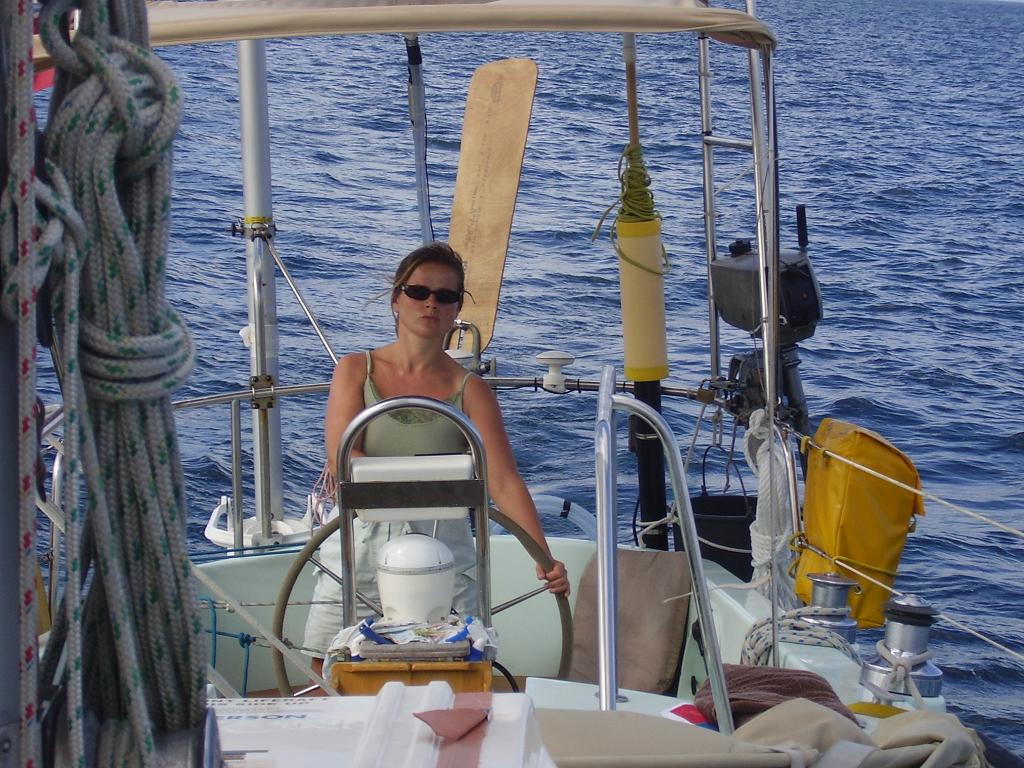
Looking forward to exploring...More to follow.
Position @ 1900: S00°53' W89°36'
Saturday, May 13, 2006
Approaching Galapagos
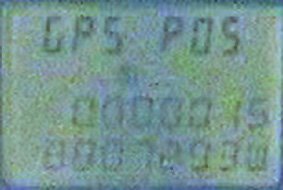
The excitement onboard is mounting. We're rapidly approaching Galapagos and at 22:50 today we passed the equator. The wind died an hour before and it felt as though "a watched GPS would never reach 00°00.00'N" such was the glacial speed the latitude counted down towards zero.
The moment finally arrived and despite prior reservations about the lack of tradition associated with staring at a GPS read-out to mark the occasion, the event turned-out to be much more exciting than my childhood memory of staying up to watch my digital watch flip from 23:59:59 to 00:00:00. Missed singing "Auld Lang Syne" though
We're hoping that the wind picks up and allows us to make landfall before dark. If not we'll have to make a call whether to heave-to and wait for daylight on Sunday or risk a night entry. Noa, who arrived today, report that the navigation lights leading to the harbour are working, so the decision will depend on the quantity of cloud cover. With a clear sky, the full-moon should make a night entry straight-forward. The lack of wind is a little frustrating as earlier today we were speeding along at 7knots+ and it looked as though we'd easily make landfall before dark.
I hope I'm not overly tempting fate to say that everything on-board is currently working well. We feel fortunate as the passage seems to have taken its toll on other boats, with Revision II and Ragtime both suffering back-stay failures - they both managed to stabilise the situation before they lost their masts - and Helene reporting a minor galley fire.
We finished the tuna today, so the line went back in, but it seemed without luck as darkness fell and I reached to reel in the line. Suddenly the elastic stretched and the the winch spun furiously. We hurriedly enacted fish drill, but the lure came back empty. We'd lost our supper. We'll try again tomorrow and hope to hook something large enough to share with Noa and Ragtime both of whom will have arrived by the time we get in.
As Ellen mentioned in the previous entry, tradition dictates that those crossing the equator for the first time are required to participate in some kind of humiliating and degrading ceremony. We discussed the standard activities such as hair shaving, eating and drinking foul-tasting food etc and decided upon foul-tasting food or rather eating something that we really don't like. I ate some of Ellen's boat-pickled beetroot. Ellen ate a small portion of one of my delicious treacle sponge puddings - which took me most of the afternoon to prepare.
Ellen decided it wasn't as bad as she'd anticipated, so perhaps I'll have to come up with some other punishment. Hope we've placated Neptune though.
Position @ 22:50: N00°00.00' W88°07'
102 miles to go.

The moment finally arrived and despite prior reservations about the lack of tradition associated with staring at a GPS read-out to mark the occasion, the event turned-out to be much more exciting than my childhood memory of staying up to watch my digital watch flip from 23:59:59 to 00:00:00. Missed singing "Auld Lang Syne" though
We're hoping that the wind picks up and allows us to make landfall before dark. If not we'll have to make a call whether to heave-to and wait for daylight on Sunday or risk a night entry. Noa, who arrived today, report that the navigation lights leading to the harbour are working, so the decision will depend on the quantity of cloud cover. With a clear sky, the full-moon should make a night entry straight-forward. The lack of wind is a little frustrating as earlier today we were speeding along at 7knots+ and it looked as though we'd easily make landfall before dark.
I hope I'm not overly tempting fate to say that everything on-board is currently working well. We feel fortunate as the passage seems to have taken its toll on other boats, with Revision II and Ragtime both suffering back-stay failures - they both managed to stabilise the situation before they lost their masts - and Helene reporting a minor galley fire.
We finished the tuna today, so the line went back in, but it seemed without luck as darkness fell and I reached to reel in the line. Suddenly the elastic stretched and the the winch spun furiously. We hurriedly enacted fish drill, but the lure came back empty. We'd lost our supper. We'll try again tomorrow and hope to hook something large enough to share with Noa and Ragtime both of whom will have arrived by the time we get in.
As Ellen mentioned in the previous entry, tradition dictates that those crossing the equator for the first time are required to participate in some kind of humiliating and degrading ceremony. We discussed the standard activities such as hair shaving, eating and drinking foul-tasting food etc and decided upon foul-tasting food or rather eating something that we really don't like. I ate some of Ellen's boat-pickled beetroot. Ellen ate a small portion of one of my delicious treacle sponge puddings - which took me most of the afternoon to prepare.
Ellen decided it wasn't as bad as she'd anticipated, so perhaps I'll have to come up with some other punishment. Hope we've placated Neptune though.


Position @ 22:50: N00°00.00' W88°07'
102 miles to go.
Friday, May 12, 2006
Dish of the day - Fresh Tuna
Wednesday evening was a momentous occasion here on Kika. Supper time was fast approaching and Nick was wondering what to serve up when we heard our fishing line turn the winch it was wound around. 'Fish Drill' then ensued which has been discussed many times before but never actually put into practice. It involves slowing the boat down and getting equipment (buckets, knives, cloths and alcohol) ready. Nick started bringing in the line and sure enough we had managed to catch a beautiful tuna about 45cm long. Apparently, the kindest way to despatch your catch is to lay it flat, cover the eye facing you with a cloth and squirt neat alcohol into its gills. This knocks it out and then the rest is up to you. I felt a mixture of sadness and excitement as I hate to see anything suffer (don't we all?), but on the other hand, I really fancied some fish to spice up our menus.
We have been enjoying it ever since and so far have had it seared with mashed potato, raw with wasabi and soy sauce, and baked with pesto. It certainly didn't die in vain! Our success with the fishing is due to advice gleaned from a truly international group. We have used tips from our Austrian, Kiwi, German, Dutch, American and French fellow cruisers and hopefully, we have now established a foolproof fishing system. We still have one tuna steak left for lunch today and after that, the fishing line will be deployed once again in the hope of fresh fish during our stay in the Galapagos.
We hope to arrive at the islands on Saturday night if the wind continues which it looks set to do. Kika is hurtling along on a port tack directly for San Cristobal, our chosen landfall. This passage has been much more comfortable than our Atlantic crossing, due mainly to the fact that then, the trades were behind us and this caused the boat to roll from side to side incessantly and maddeningly. Currently, the wind is coming from an angle of about 45 degrees which means that we heel quite dramatically but we maintain that position until we choose to tack. The boat also pitches at times due to the sea state. This is a rocking motion but from bow to stern rather than side to side, and I find it quite pleasant!
For the past two evenings we have been joined on our journey by a couple of chattering seabirds. Not sure what they are as it's always dark when they arrive but it's nice to see their silhouettes in the moonlight and hear their 'talk'. It's a sound I've never heard from a bird before, a sort of tutting - it sounds like they're are scolding one another (or perhaps us!) I was also accompanied by a few dolphins tonight who startled me with their noisy blowing. It's always an unexpected but very welcome sound because you know you're in for some fun when you hear it and it really takes the edge of the solitariness of a night watch.
Not long now until we cross the equator. Should happen some time within the next 24 hours and we have a ceremony to perform for King Neptune! This customarily involves those who have 'crossed the line' before (aka shellbacks) ridiculing and humiliating those who haven't (polliwogs). We're all polliwogs here though (Kika included) so we shall have to be inventive!
Position @ 0200 (0700 UTC): N01°13' W86°46'
Distance to go: 213nm
We have been enjoying it ever since and so far have had it seared with mashed potato, raw with wasabi and soy sauce, and baked with pesto. It certainly didn't die in vain! Our success with the fishing is due to advice gleaned from a truly international group. We have used tips from our Austrian, Kiwi, German, Dutch, American and French fellow cruisers and hopefully, we have now established a foolproof fishing system. We still have one tuna steak left for lunch today and after that, the fishing line will be deployed once again in the hope of fresh fish during our stay in the Galapagos.
We hope to arrive at the islands on Saturday night if the wind continues which it looks set to do. Kika is hurtling along on a port tack directly for San Cristobal, our chosen landfall. This passage has been much more comfortable than our Atlantic crossing, due mainly to the fact that then, the trades were behind us and this caused the boat to roll from side to side incessantly and maddeningly. Currently, the wind is coming from an angle of about 45 degrees which means that we heel quite dramatically but we maintain that position until we choose to tack. The boat also pitches at times due to the sea state. This is a rocking motion but from bow to stern rather than side to side, and I find it quite pleasant!

For the past two evenings we have been joined on our journey by a couple of chattering seabirds. Not sure what they are as it's always dark when they arrive but it's nice to see their silhouettes in the moonlight and hear their 'talk'. It's a sound I've never heard from a bird before, a sort of tutting - it sounds like they're are scolding one another (or perhaps us!) I was also accompanied by a few dolphins tonight who startled me with their noisy blowing. It's always an unexpected but very welcome sound because you know you're in for some fun when you hear it and it really takes the edge of the solitariness of a night watch.
Not long now until we cross the equator. Should happen some time within the next 24 hours and we have a ceremony to perform for King Neptune! This customarily involves those who have 'crossed the line' before (aka shellbacks) ridiculing and humiliating those who haven't (polliwogs). We're all polliwogs here though (Kika included) so we shall have to be inventive!
Position @ 0200 (0700 UTC): N01°13' W86°46'
Distance to go: 213nm
Wednesday, May 10, 2006
Wind shift in our favour
We're doing well, we have under 400 miles to go to the welcomingly named Wreck Bay in San Cristobal Island, our chosen destination in the Galapagos. The wind has shifted to the SSW so we're able to steer much closer to the rhumb-line course. The weather faxes indicate that the wind should back further to the S or SSE which if the predictions prove correct we should be able to make landfall without tacking. We currently have 15 knots of wind which is pulling us along nicely at 5.5-6 knots without generating a large uncomfortable head sea. Although the contrary current reduces our speed-over-the-ground to just below 5knots. This is still very good news for this passage which is renowned for boats running short of diesel after trying to defy the light-head winds and strong currents by motoring.
George our wind-vane steering is doing a fine job following the wind as it backs in our favour although earlier on in the trip, he silently followed the wind to the north, retracing our steps for over an hour until we noticed and tacked back towards the south. He seems to steer a much better course close to the wind than with the wind behind us; we experienced significant yawing crossing the Atlantic, but perhaps we're just getting better at balancing the sails to make his job easier. He even tacks for us when we're short handed during the night. The routine is to trim the vane for the new tack, George then puts the wheel hard-over and leaves us free to release the genoa sheet on one side and pull it in on the other side. Once we're round George happily steers on the new tack all without waking the person asleep below - unless the noise of the contents of the cabin shifting sides as Kika leans into the new tack breaks their slumber.
The contrary current is the source of much discussion on our radio nets. Boats further north are suffering from very light-winds and strong currents and there's a noticeable frustration in their voices as they give their position and despairing ask if anyone knows whether to head south or west to escape the current. At the start of the trip we noticed areas of disturbed water on an otherwise calm sea, almost like the tidal rips seen around head-lands and they made a similar lapping sound on the hull as we ploughed through the short steep waves. All very strange as there was no charted uprising.
We put out our latest fishing line yesterday and this morning. Other boats have reported catching Tuna and Mahi mahi, but so far we haven't even had a bite. This line represent an evolutary leap over the lines we deployed across the Atlantic. It uses a double hook, beads to space the hook from the head of the lure, a squid lure with moving eyes, single strand wire leader, the line bought back to winch such that it will spin and alert as if a fish bites and finished off with a length of elastic to take the initial shock out of the bite. Yesterday as I deployed our new fishing system I felt supremely confident that we'd be eating fresh fish that evening. Today it's not looking so good - but watch this space...
Position @ 15.45: N02°48' W84°36'
Tuesday, May 09, 2006
Making Progress
At last, we are making progress in almost the right direction. The wind has backed to the SSW and we can make a WSW course though the lumpy sea is making it quite heavy going. It feels like we're doing 8 knots with all the spray, noise and motion, but in fact we are only doing 5-6.
Despite the challenge that the wind has posed for us, this passage has been the most enjoyable for me so far as I haven't felt seasick - it makes such a difference as the whole experience is less of a struggle and more fun. I'm sure Nick feels the same!
Yesterday was spent cooking, reading, chatting and sleeping. We've been looking out for wildlife, but not much other than the odd solitary sea bird and a flying fish which happened to land on my lap last night. Busy day planned today with fishing and boat improvements on the agenda although I do feel loathe to drag out the sewing machine and start working on the deck shade when the boat's heeling 25 degrees. Call me old fashioned if you like, but I prefer not to dice with gravity where a sewing machine the weight and size of an anvil is concerned. If it's calm though, I'll have a go.
Position @ 0200 (0700 UTC): N03°07' W82°21'
Sunday, May 07, 2006
Slow progress south in light winds
We've made it through the doldrums (the ITCZ - Inter-Tropical Convergence Zone), which lived up to its reputation for thundery weather. However the wind hasn't picked up significantly and we're doing our best to sail with the occasional breeze. The sea is calm which makes it easier to harness the little wind, although unhelpfully it's blowing from the SW - the direction we're heading. For the first time on a long passage we're sailing close-hauled and tacking.
The contrast between the last two nights is great. Last night, was a bright star filled night, the previous evening, the darkness was impenetrably black, occasionally illuminated by lightening flashes of the thunder storms surrounding us. Our spirits lifted yesterday when we spied our first blue sky for two days and emerged from the persistent tropical downpour.
At least Kika has had a good wash-down and cleansed herself from the inevitable covering of grime during our stay in Colon. We're making use of the calm conditions to complete a few jobs. We repaired the head-sail and made some "baggy wrinkles" which we'll attach to the shrouds to reduce the chafing of the main-sail when we sail downwind. We bought an old hand-powered sewing machine in Colon and some material to make a deck shade, hopefully the calm rain-free conditions will allow us to start work.
The distance to the Galapagos didn't look that great before we set off, but as we slowly zig-zag our way towards the Equator it looks like it'll take us a while before we make landfall.
Position @ 10.30 (GMT -5): N4°37' W81°09'
The contrast between the last two nights is great. Last night, was a bright star filled night, the previous evening, the darkness was impenetrably black, occasionally illuminated by lightening flashes of the thunder storms surrounding us. Our spirits lifted yesterday when we spied our first blue sky for two days and emerged from the persistent tropical downpour.
At least Kika has had a good wash-down and cleansed herself from the inevitable covering of grime during our stay in Colon. We're making use of the calm conditions to complete a few jobs. We repaired the head-sail and made some "baggy wrinkles" which we'll attach to the shrouds to reduce the chafing of the main-sail when we sail downwind. We bought an old hand-powered sewing machine in Colon and some material to make a deck shade, hopefully the calm rain-free conditions will allow us to start work.

The distance to the Galapagos didn't look that great before we set off, but as we slowly zig-zag our way towards the Equator it looks like it'll take us a while before we make landfall.
Position @ 10.30 (GMT -5): N4°37' W81°09'
Saturday, May 06, 2006
Update from Ellen
Half past midnight and there is very little wind so we are motoring. It has been raining on and off all day with thunder storms rumbling close by, and there is now a steady drizzle punctuated by the odd dramatic flash of lightening which serves to illuminate an otherwise black night. I'm cooler than I have felt in months (am actually wearing trousers) which is nice, but all is very damp inside and out the boat, which is not pleasant, as ventilation can be a problem when underway. Hope tomorrow is drier. During a major downpour earlier on in the day we had cockpit showers which was very refreshing.
Today has been spent repairing the wind-vane (after servicing in Panama, he had been reassembled incorrectly!) and eating perishable food (watermelon, pineapple, bacon and tomatoes) as we have a vast amount and if we pace ourselves too strictly, it will all go off (well that's our excuse). We have also joined two nets for this trip - one in the morning and one in the evening. The evening net consists of about 5 buddy boats who, like us, have all just left Panama for the Galapagos, so we are not alone out here by any means.
Nick and I are experimenting with watches, just to see if a different system is more suitable for us. With the old watches of 6 to midnight and then midnight to 6, it meant that my watch was always in complete darkness, and also, Nick found that he didn't sleep for the full 6 hours, so we have shortened the watches to 3 hours and will see how that goes.
Position 0100 (0600 UTC): N6°19' W80°33'
Distance to go - about 700 miles!
Monday, May 01, 2006
Into the Pacific
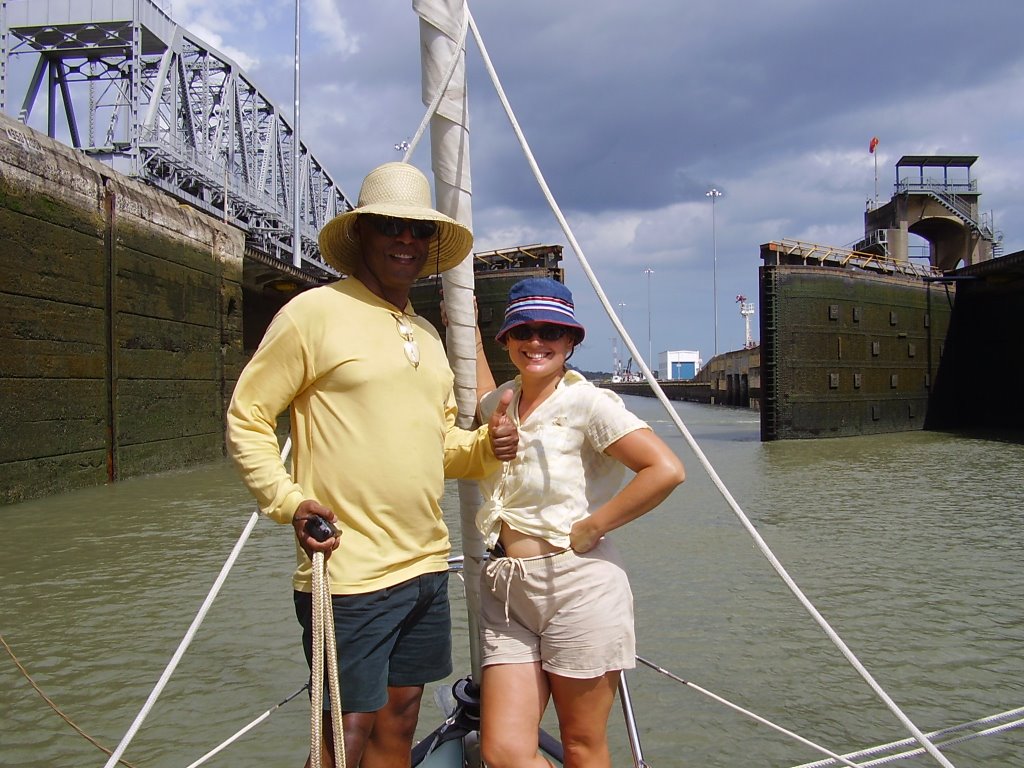
Our time in Colon is finally over. There were moments when it felt like our sentence would never end. Despite our three week wait, we were still putting the boat into a workable state the morning of our transit. We'd planned to head up a nearby river the Wednesday before to give the engine a good work-out after the pre-Pacific service we'd given it. Unfortunately we ran out of time and only managed half an hour round the anchorage, but everything seemed to working well, until we picked up our advisor (trainee pilot). Then all manner of afflictions appeared to infect the engine; stalling in neutral, loss of power at high revs. We didn't instantly warm to our advisor and I was concerned that if he sensed a problem he wouldn't let us go through. The prospect of another three weeks in Colon hung over us as we circled in front of the Gatun locks for over an hour. Our tension eased considerably when we finally formed our lock transiting raft and "Midnight Blue" the middle boat of the raft provided the horse-power to pull us through. By midnight we'd made it through the three Gatun locks, tied to a buoy in the lake, bid farewell to our advisor and tucked into a delicious late supper. While other crews sat in their cockpits enjoying the sounds of the jungle we set to work on the engine. Fairly quickly we diagnosed air in the fuel and by 1am we'd fixed the problem. It transpires that I'd incompetently replaced the fuel filter and air was finding its way between the gasket and the filter. Many thanks to Ken from Eagle's Wings, one of our line-handlers, who'd suffered a similar issue with his generator and rapidly pin-pointed our problem.
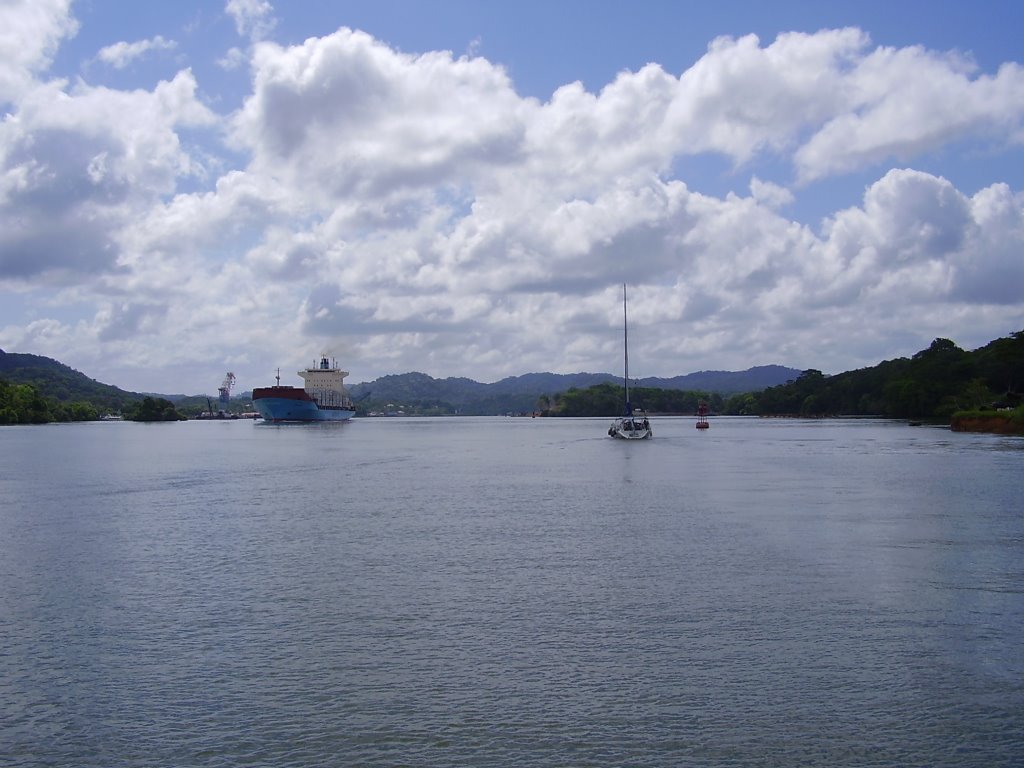
At 7am we were joined by Ricardo our advisor for the trip across the lake. The atmosphere on-board was celebratory as we motored through the beautiful jungle landscape without a glitch.
The focus then turned to how to contact the person who controls the view from web-cam in the Miraflores locks.No-one appeared to know for certain which of the many cameras around the lock was the web-cam, so we took no chances and waved madly at each camera in turn.
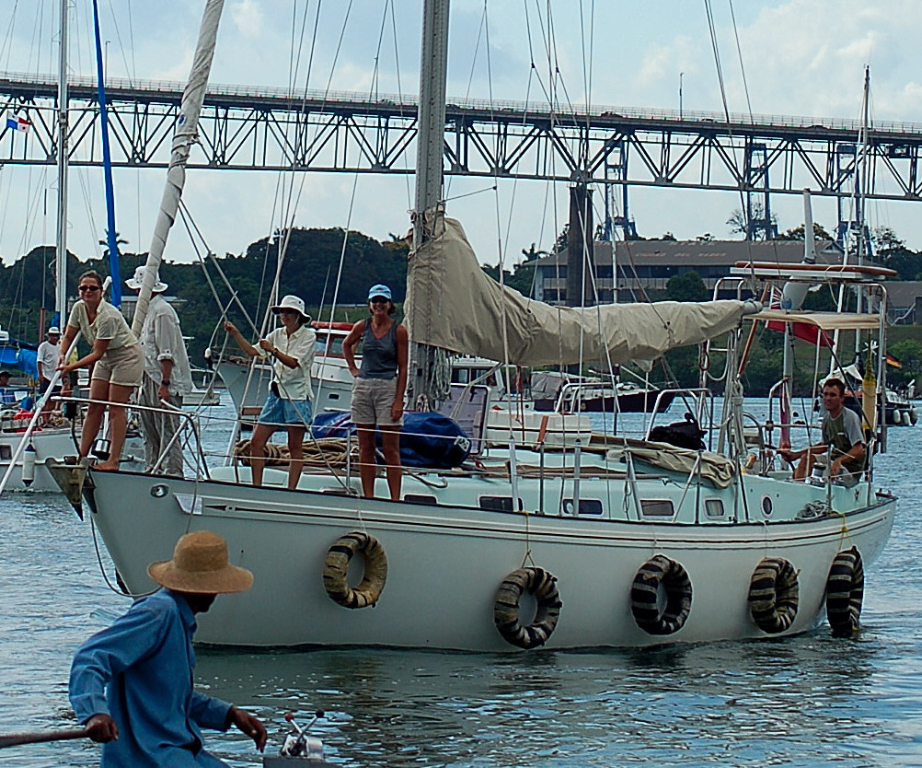
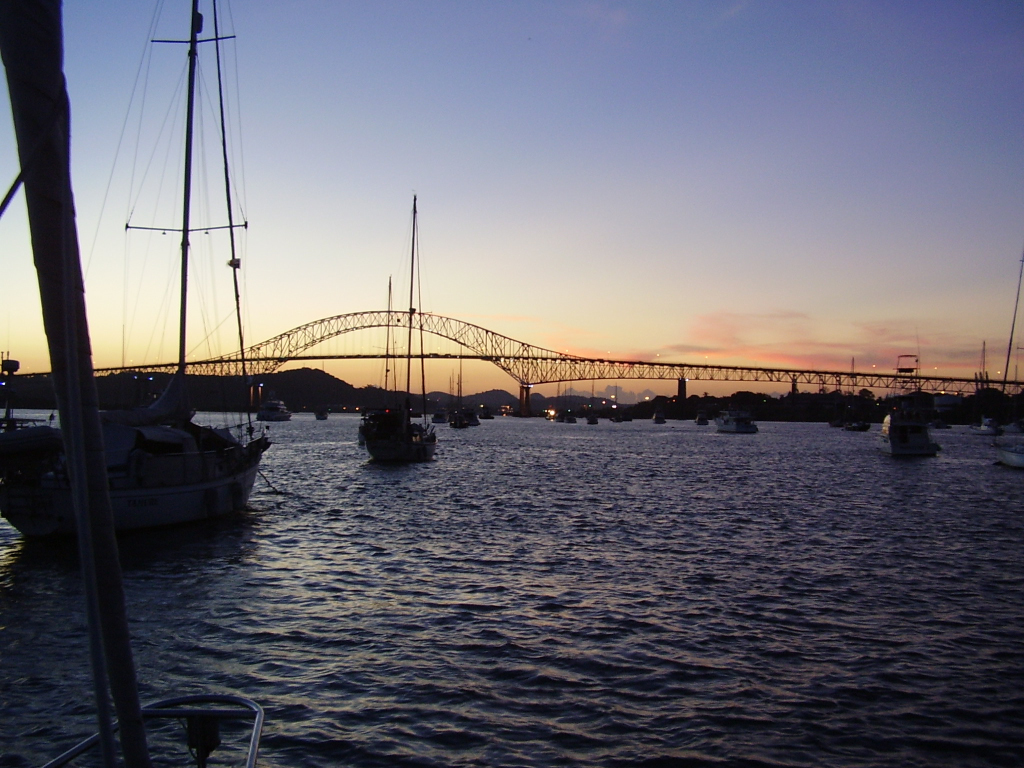
Just before 3pm the last of the lock gates opened and we entered the Pacific.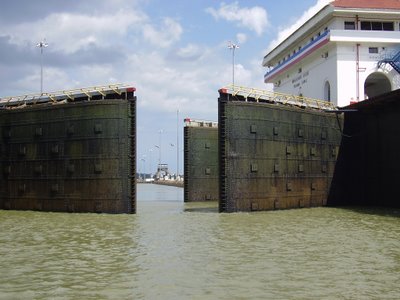 As we approached the mooring in Balboa we were greeted by fellow inmates from Colon. Noa and Ragtime waved back at our ecstatic grins - we'd finally made it. Much thanks to our fantastic crew of line-handers - Beth and Ken from Eagle's Wings and Anne from "Flyer".Ricardo proved to be excellent company, as a story teller, relating the history of the canal and finally persistently trying to call the web-cam operator.We just had time to take in our new surrounding before being whisked ashore to share a celebratory drink with Tim from "Midnight Blue". Tomorrow we'll fill up with fresh food and soon after head off into the unknown for the Galapagos
At 7am we were joined by Ricardo our advisor for the trip across the lake. The atmosphere on-board was celebratory as we motored through the beautiful jungle landscape without a glitch.
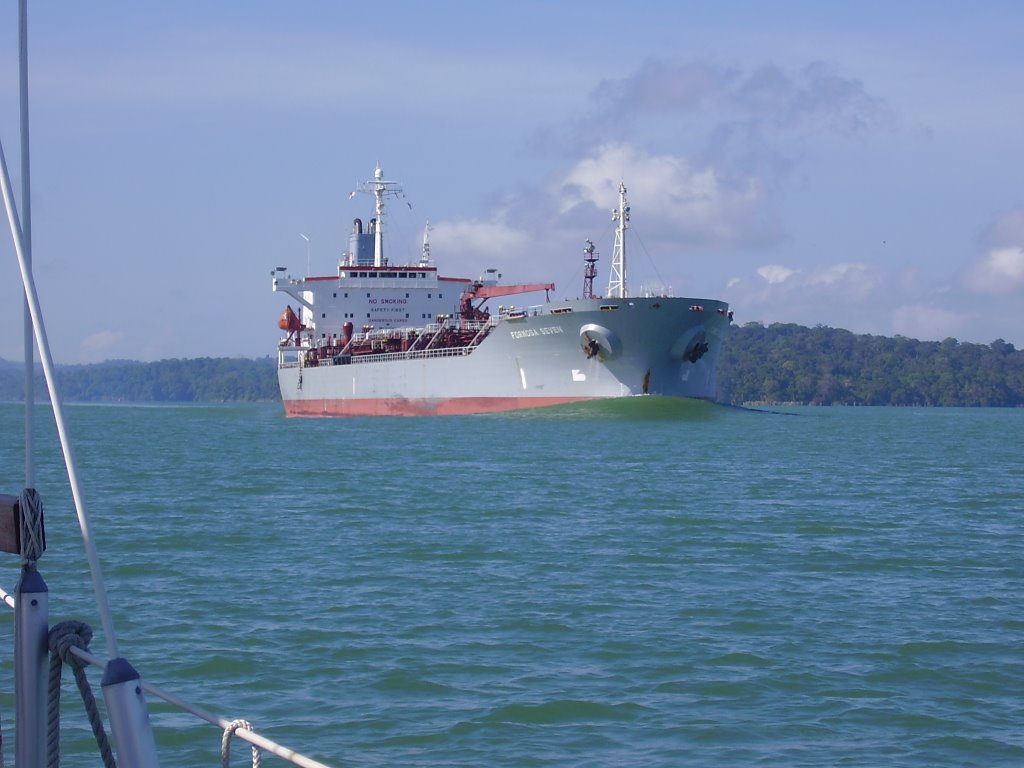
The focus then turned to how to contact the person who controls the view from web-cam in the Miraflores locks.No-one appeared to know for certain which of the many cameras around the lock was the web-cam, so we took no chances and waved madly at each camera in turn.
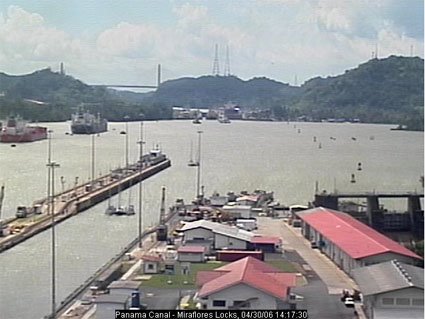

Just before 3pm the last of the lock gates opened and we entered the Pacific.


Subscribe to:
Posts (Atom)

